Showing posts with label College Board. Show all posts

Monday, August 26, 2013

Reality Check: Obama is Standing for Students

Since when did an effort to ensure that students receive a high-quality affordable education in exchange for their financial aid become unconstitutional micromanagement of colleges and universities?

This is where the rubber hits the road, folks. Where the needs of a particularly elite form of academia comes into conflict with the average student's right to an affordable public education. And apparently it's about to get ugly. 

Don't believe the hype. President Obama is not attacking faculty, he is not seeking to destroy public colleges and universities which are the workhorses of higher education, and for pete's sake he is not proposing a pseudo-NCLB for higher education.

The President's main goal is simple:  After decades of hoping that students could hold institutions of higher education and states responsible for providing a high-quality, affordable college experience that leads to degrees, he's calling the nation's attention to the fact that the market isn't working on its own and some really serious regulation is needed.  The federal government is a major financial player in higher education, far more so than in k-12, and it has a responsibility to ensure that the schools it funds do right by their students.  

Despite their loud claims to the contrary, many schools are not currently doing right by their students. Some of them are setting prices so as to absorb all available financial aid and providing students with few supports and long-shots at completing degrees. Others are taking advantage of the availability of student loans to charge the middle-class sky high prices while hiding behind "admissions standards" to leave the majority of students from the 99% out in the cold.  In addition, there are a lot of federal dollars spent unnecessarily, supplanting resources from institutional endowments. Finally, there are plenty of childish states, pulling back on their investments when the federal government provides support. 

All of that should be stopped by holding colleges, universities, and states to the standards that we now hold students.  The problems we face in higher education today are largely due to the behaviors of those institutional actors--not students.  The federal government must use the strings associated with Title IV to ensure that college administrators, boards, and state legislatures behave themselves and let the students and faculty get back to the hard work of education.

That's the goal. It's where Obama is headed, if you'll just give him a chance to get there.

And when he does: NO, this will not make student aid more complicated.  Instead of rules for millions of students we can have a much smaller set of rules for the few thousand institutions. Done right, this will not punish students for the acts of their states and institutions. It will not further push education towards earnings and away from learning.  It should do the opposite-- it focuses on the actual problem-- schools that claim to educate students while merely sifting and winnowing out the ones it doesn't want, schools that recruit students only to leave them behind once checks are signed. It helps direct students towards the states and institutions where their aid will be used well.  It helps ensure that students get degrees--which is the very least they deserve (and come on, don't tell me that in your day you really earned your degree...).

Suggesting the opposite-- suggesting that this effort will hurt students-- is a red herring. It's a line tossed about by privileged elites who have claimed to serve America's middle class while restricting enrollment through selective admissions, and promoting rhetoric that allows some elite colleges to stand on high above their peers, endlessly wealthy and exerting strong influence, helping to push millions of Americans into debt. 

Beware of these scare tactics. The President isn't going to cut students' Pell dollars. He's never going to assign letters grades to each colleges and university.  He's not bringing in standardized tests or value-added modeling for professors, or giving colleges incentives to get rid of teacher tenure or privatize.

Unfortunately, he's also not about to make college--or at least community college-- free.  Now there's something worth critiquing him for.

Sure, the President did make some errors in his plans. He should never have likened this effort to the ridiculous College Scorecard or called them "ratings"-- that trivialized the approach.  He should have challenged schools to improve to certain standards before the move to link aid to institutional performance rolls out.  Race to the Top should never have been a part of this at all, since doing this fast has never been a good way to bring about quality change. He should never have mentioned MOOCs or other such untested approaches to cutting costs, and in fact, he needn't have mentioned specific practices for cost-cutting at all.  That can and should be left up to the institutions to deal with-- he simply needs to tell them what goal posts to aim for and what the rules of engagement are.   For example, he should have reiterated the importance of educators to education, and assured the faculty of their very real place in affordable higher education. He should have placed much more emphasis on the importance of public institutions and the role that states must play in adequately funding them if those states want to get any Title IV funds for their private or profit schools.   

Shoulda, woulda, coulda.  The fact is that the current financial aid system has benefitted colleges and universities-- and states-- far more than students for a very long time, and President Obama is finally going to try to do something about it.  Did he get the plan exactly right on this initial roll out?  Nope. Will it be accomplished in the next few years? No way.   But that isn't and wasn't the point.  He is standing up for students and families and telling higher education administrators and states that they must get some skin in the game-- or get out of Title IV.   It's about damn time. 
Monday, August 6, 2012

Wisconsin Needs to Educate, Not Incarcerate

Yet another policy brief highlights what realists know:  Wisconsin policymakers are presiding over poor policy decisions that threaten to undermine taxpayers' decades-long investment in the state's human capital.

Far from saving our children from lifetimes of debt, those on the neoliberal Left and the conservative Right advocating for either "freeing" state universities from the limitations of state funding in pursuit of market models, or diminishing state spending in a time of austerity, are accomplishing the same goal:  driving up the costs of college attendance and reducing the overall educational attainment of our state's workers.

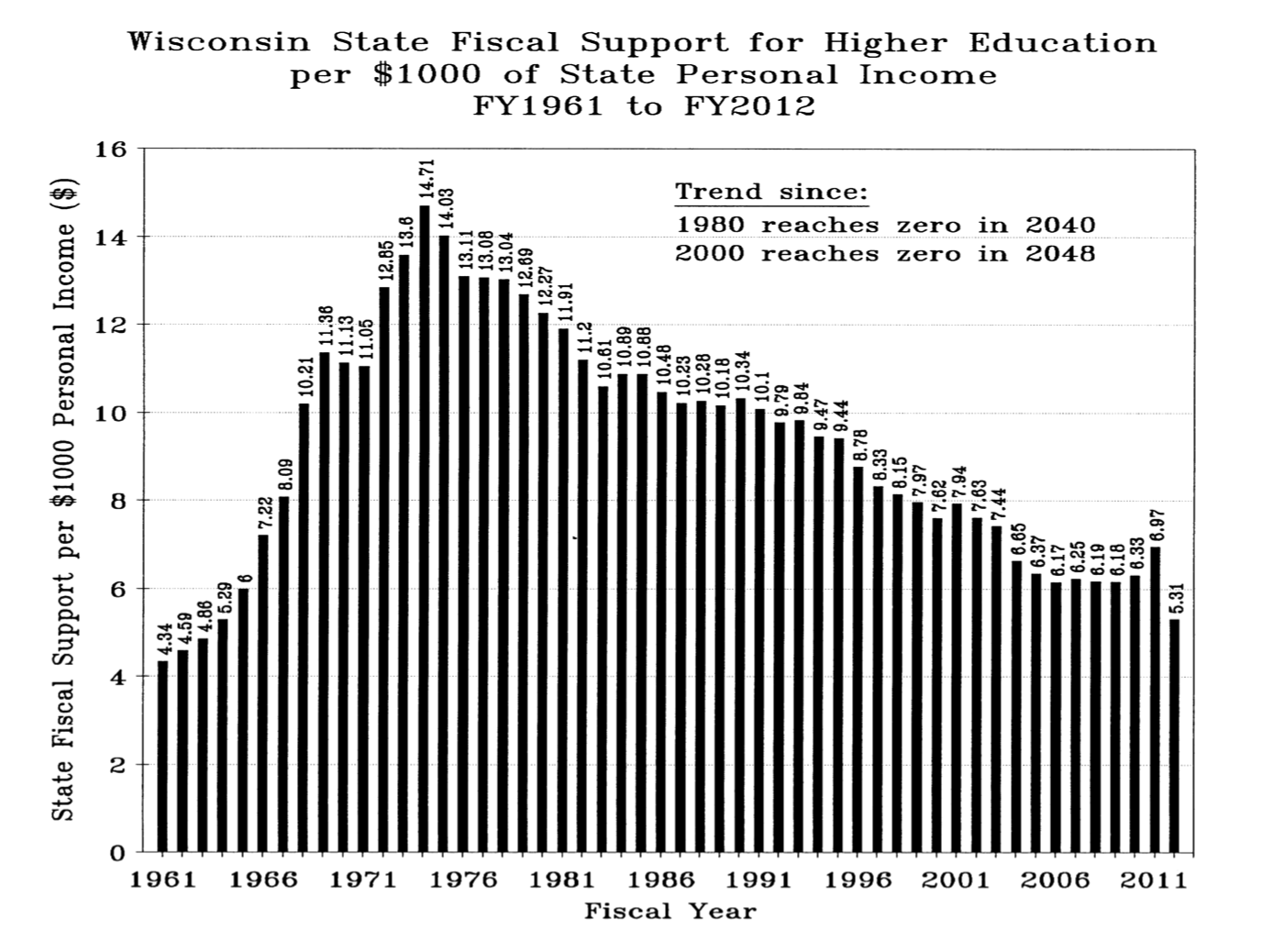
Forty years ago our grandparents elected officials who invested $14 per $1000 of personal income in higher education.  Today, we elect jokers who put in just $5.  What happened?

Figure courtesy of Tom Mortenson, Postsecondary Education Opportunity
Let's admit it: we aren't leaders anymore, we're laggards. Yes, Wisconsin pays taxes, but we throw away far too much of it on other things.  According to Figure 4 in the new report I referenced above, we rank 32nd thanks to the policy choice displayed above-- relative to per capita income, we are outspent by the likes of Mississippi, Alabama, and West Virginia, not to mention our neighbors Illinois, Indiana, Iowa, and Minnesota.

Where is that money going instead? One simple word answers the question: corrections.  To paraphrase Ronald Reagan, we fought a War on Drugs, and drugs won-- but heck, we are still throwing our money at the problem.  Legacy spending, you might call it.   Over the last 10 years, spending on corrections went up 9%, while spending on k12 dropped by 6% and spending on higher education dropped 20%. Right, because clearly the goal of Wisconsin taxpayers is not to help educate our children, but rather to lock 'em up and shut 'em up.

For those who manage to avoid prison and get into college, instead of investing in their future, Wisconsin taxpayers seem to want their families to foot the bill. How's that working for us? Well, enrollment in our public institutions is lagging behind those in other states.  We have experienced far slower growth in fall enrollment as measured over both 5-year and 10-year periods, compared to the national average (see Table 6 here). Perhaps most startling is how little enrollment in our 2-year colleges has changed-- there was practically no change at all in enrollment there over the last 5 years (0.6%) while the national average was 16.7%! Perhaps not coincidentally, during that time, tuition and fees at the 2-years (already higher than the national average 5 years ago) rose by 20%.

I have to admit being persistently perplexed at how other parents throughout Wisconsin can sit idly by while we pour money intended for our kids into pits of despair like the state's correctional facilities.  It is far more cost-effective to educate rather than incarcerate.  It's time to make our policymakers do right by the limited dollars we have. Let's re-instate a real early release plan, and rollback the ridiculous "truth in sentencing" guidelines that lengthened parole time, greatly increasing the likelihood of being returned to prison. As UW-Madison expert Walter Dickey notes, there are numerous hidden costs to incarceration, and as state we simply can't afford to be in the corrections business.   

The best solution is to treat education as the crime-fighting technique it really is.  Providing young people with truly viable opportunities later in life gives them something to really aim for, helping keep them off the streets and on the job.  A recent UW-Madison graduate, economist Ben Cowan, finds that a $1,000 reduction in tuition and fees at two-year colleges is associated with a 26% decline in the number of sexual partners an adolescent has, and a 23% decline in number of days in the past month he used marijuana.  Policies that support affordable higher education may simultaneously support reductions in the costs of incarceration, in a virtuous cycle that is win-win for all.

This is pure common sense and we all know it.  It's simply time we demand that our "leaders" catch up.


Friday, January 7, 2011

A New Year


We hope all our readers enjoyed relaxing holidays and have returned refreshed for the new year. While our family and professional lives continue to make it difficult to blog with great frequency, we hope you'll continue to read our infrequent commentary and join in the discussion during 2011.

A few thoughts to start the new year...

(1) Outcomes First? If outcomes are what really matter in education, it is interesting that so many advocates, commentators and policy organizations seem to count adoption of favored policy reforms as ends in themselves. We are all guilty of this to some degree. It is only when there is a research base to suggest that specific reforms and programs work that there is a strong argument to be made. Examples might include targeted class size reduction in grades k-3, high-quality early childhood education, and comprehensive, multi-year induction support for new teachers. But, at a macro level, certain arguments fall apart when there is no evidence to back them up, such as teachers' unions being a wart on the ass of progress. Take Massachusetts, for example, a strong union state. It leads the nation in TIMMS scores in spite of the fact that the Massachusetts Teachers Association looms large in state politics.

(2) Teachers, Teachers: One of the best developments of 2010 was an increased focus on teachers and on teacher effectiveness in particular. This focus was not always for the better, as in the case of the Los Angeles Times' decision to publish value-added scores for individual teachers or the misleading, union-bashing documentary Waiting For Superman. But an overall focus on the outcomes of teaching is the right policy conversation to be having. However, that conversation must lead to solutions that create comprehensive structures and systems to maximize benefits for all involved -- students, teachers, parents, etc. Regular feedback about teaching is critical for educators, not just summative data or annual evaluations that don't provide actionable feedback. A key goal around improving teacher effectiveness should be the development of schools and districts as communities of practice that make teaching more of a collective endeavor and support all educators to strengthen their individual practices and skills.

(3) ESEA: I am increasingly of the mind that something -- but not much of anything -- will happen with regard to reauthorization of the Elementary and Secondary Education Act in 2011. If successful, reauthorization will primarily serve as a token of bipartisanship that both parties can carry into the 2012 elections to say "we can work together to get things done." If accomplished, it may be one of the few significant bipartisan accomplishments of this Congress. Look for substantive tweaks to the No Child Left Behind Act rather than a wholesale overhaul of it. More flexibility around AYP. Attention to the needs of rural districts. More local control. Perhaps a stronger focus on teacher performance pay, charter schools and school choice options -- some elements of the Obama Blueprint combined with priority issues for Republicans like John Kline and Lamar Alexander. And level funding, at best.

(4) Exclusivity: One of my wishes for the New Year is that the DC echo chamber would become less and less influential in conversations about education policy. I am constantly amazed at how regularly the usual suspects parrot, squawk about and retweet the comments and ideas of the other usual suspects, especially those with whom they have personal or proprietary relationships. And how the same usual suspects are quoted saying the same usual things by the mainstream and educational media. This dynamic plays out, too, in conversations within multiple exclusive fiefdoms within education that generally have little to no intersection with fiefdoms with competing worldviews or different policy priorities. As someone who once worked in DC and who now works for a non-DC-based national non-profit organization that has relationships with all sides of the education community, I am especially cognizant of this dynamic in which voices outside of the Beltway 'influentials' are not heard.

One alternative stream recently profiled by Rick Hess and Jay Greene are academics doing policy-relevant research and cutting a high profile in policy conversations. We need more of that type of intellect in play -- and not just from economists. Another is the rise of state-based reform groups like Stand for Children, the PIE Network, Delaware's Rodel Foundation and Oregon's Chalkboard Project. Finally, the voice of actual teachers is too often missing from policy conversations. Fortunately, there are numerous efforts afoot to remedy this. Two, in particular, worth checking out are Teach PLUS and the VIVA Project. My organization, the New Teacher Center, in conjunction with the College Board, recently profiled real-life teachers in a publication about the importance of teacher mentoring.

One way or another, 2011 undoubtedly will be an interesting year for education.

Monday, April 26, 2010

Race and Debt

The College Board's Advocacy and Policy Center reports that "too many students are borrowing more than they are likely able to manage" and this is particularly true for black undergraduates. According to researchers, fully 27% of black BA recipients borrow more than $30,000 for college, compared to 16% of white BA recipients. The gap is especially large among independent students (those who are a bit older, are parents, or independent for other reasons)-- more than 1 in 3 black independent students who earn BA's graduate with high levels of debt, compared to less than 1 in 4 white independents.

This is a trend we need to know more about. There have been a few articles written about race differences in college financing patterns and receptivity to financial aid, but none have been especially adept at sorting out the underlying reasons for variation by race/ethnicity. Are the patterns attributable to factors which map onto race in this country (e.g. poverty, segregation, school quality, etc) or to factors more closely related to beliefs, expectations, values, etc?

I'm working on this question in the context of a study I co-direct in Wisconsin. The Wisconsin Scholars Longitudinal Study is exploring the impact of need-based financial aid on college outcomes. We've got very rich survey data from students' first two years of college, as we explore it we're beginning to learn a lot. For example, the data (from a sample of more than 2,000 Pell Grant recipients attending 2-year, 4-year, and technical colleges) indicate that black undergraduates are far more likely than white students to know who to contact in their financial aid office and to seek out help, yet at the same time they are less likely to feel comfortable doing so. They are twice as likely as white students to fill out the FAFSA without any help, and almost half as likely to get FAFSA assistance from a parent. In their first year of college alone, they are more than twice as likely to report receiving a private, non-federal loan.

As the College Board report concludes, too much college debt can contribute to future financial insecurity. Many of us hope that increasing rates of educational attainment among students from racial/ethnic minority backgrounds will perpetuate a virtuous cycle benefiting all families-- but those prospects will undoubtedly be diminished if debt takes its toll.


Image courtesy of John Fewings


Posting Lama ►
 

Followers

Alexa

Copyright 2013 Education for Everyone: College Board Template by CB Blogger Template. Powered by Blogger