Showing posts with label Rebecca Blank. Show all posts

Wednesday, April 3, 2013

Advice for Chancellor Blank from a UW Employee

This afternoon I received the following email from a UW employee who, unlike myself, does not enjoy tenure and thus prefers to convey this advice to the incoming chancellor anonymously.  I recognize and sympathize with that concern, and thus am simply reprinting it here in full.  I believe this advice, coming from someone with plenty of experience at the institution, is worth full consideration. If you have your own words of advice to share, please send them along!


Dear Dr. Goldrick-Rab –

If Dr. Blank is willing to listen to you, and I hope she does, one thing you might want to suggest is that she does not start calling herself “Becky” but instead be referred to as Rebecca when she wants to go “casual.”

David Ward was never been referred to by anyone as “Dave,” and if John Wiley had a nickname or pet name as a child, he certainly did not use that on his official correspondence or when he was quoted in the press.   This is, after all, the University of Wisconsin-Madison.   Excellence in teaching and research is how we convince people to give us their money or send us their children to educate

Trying to be cute or folksy is not what the alumni, citizens, or corporate  and foundation donors are looking for.  Two of my children were enrolled at UW-Madison when “Biddy” was the Chancellor, and neither one of them understood where the widely reported “love” that all the students at Wisconsin supposedly had for Biddy came from.

Thank you.

Friday, March 22, 2013

Cautions for Chancellor Blank

It seems UW-Madison's system of shared governance may be a new act for Chancellor Rebecca Blank to learn.  An interview conducted with journalists today shows her on the record weighing in on both tuition strategies and the composition of the student body.

A word to the wise:  This year the University Committee charged two committees to work on these exact issues.  The tuition committee has been meeting and working hard all year long -- hiking out-of-state tuition and differentiating tuition further by school or college are strategies that come with significant potential consequences.  Reciprocity with Minnesota is costing the university a great deal of money and ending it should not be dismissed out of hand.  Regardless, these are not choices made simply by the chancellor, but by the shared governance system.  In addition, the Committee on Undergraduate Recruitment, Admissions, and Financial Aid was tasked with developing a profile of the ideal freshman class and working on ways to achieve it.  Chancellor Blank does not decide where students "should" come from-- we all do.

Hopefully these are just initial missteps on her part. Hopefully the next time she is asked about these things, she'll inform reporters that it's impossible at this stage to say what will come next, since she hasn't spent time on campus in decades.  And hopefully she will schedule a "telebriefing" with shared governance groups soon, seeing as how the one with reporters is now over.

Tuesday, March 19, 2013

UFAS Reaction to Appointment of Rebecca Blank as Chancellor


This post is by Chad Goldberg, Professor of Sociology at UW-Madison and Vice President of United Faculty and Staff, the campus unit of the American Federation of Teachers. As a card-carrying member, I am proud to provide this outlet to Chad to share his thoughts.

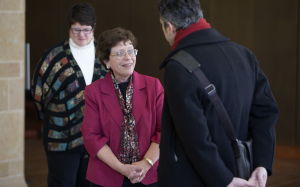
Chad and Rebecca meet, 2013


Monday, March 18, 2013

Welcome, Chancellor Rebecca Blank


This blog is called the Education Optimists and so it's with great hope and the strong desire to be pleasantly surprised that I am responding to the announcement that Dr. Rebecca Blank is the next chancellor of UW-Madison.

First, the good news.  With Blank at the helm, we can expect that the thoughtful scholars of the Institute for Research on Poverty and the La Follette School of Public Affairs will play an important role in the direction of our institution in coming years.  I suspect policy formation on affordability and tuition will be guided by Bob Haveman, Chris Taber, and Karl Scholz, efforts on diversity and access will be led by Bobbi Wolfe, and our interactions with social policies throughout the state will be shaped by Tim Smeeding. These labor economists are experts in their field, and will undoubtedly constitute a vocal cabinet for Blank.  

Second, the Social Sciences will flourish under Blank's direction. As a sociologist, that's nice to know.

Third, I expect Blank will surprise me by being an entirely different leader than Biddy Martin, stunning us all with her commitments to widening access to UW-Madison and keeping it affordable.  Her expertise is in poverty studies, and so I hope that under her policies, we will see far more students from low-income Wisconsin families take their places in our classrooms.   Twenty percent or more of our student body should receive Pell Grants, and the percent of students from first generation families must begin to rise.  If she can accomplish this, I will loudly applaud.

So- I'm pleased as punch to be putting the word Chancellor next to Rebecca Blank's name, especially given that the apparent alternative was Kim Wilcox.  I suspect Blank was the campus "pick," if that matters.  As for me, I hope that some day I will get to work with Michael Schill-- and at minimum I won't soon forget how sincerely he tried to serve Wisconsin by taking the helm. In the meantime, I'm looking forward to my coming sabbatical and the next many years freed from campus service;  with so many existing campus friends and experts in the relevant areas, Dr. Blank is well-equipped to decide how to achieve her goals. Godspeed, and On Wisconsin!


Friday, March 15, 2013

UW-Madison Students Weigh in on Chancellor Candidates

Two letters from students are circulating on campus this morning. Here they are.


Thursday, March 14, 2013

On What Matters: Blank vs. Schill


My email inbox has been filled today with notes from upset colleagues who seem to feel I've misjudged Rebecca Blank's capacity for leading UW-Madison.  They don't understand, I'm told, how I can overlook her clear talents, deep commitments to social justice, and great scholarship.

I don't think I am.  I don't doubt any of those things.  This isn't about whether I like her or think she can do the job. The question is for which candidate -- Michael Schill or Rebecca Blank-- do we have the best evidence of success at UW-Madison.

I'd like to lay out more data for your consideration.  These are the types of things that led to my assessment, and so I encourage you to look for yourself, and then provide your input by tonight! (The committee will vote in the morning). Write to: Chancellor-search@secfac.wisc.edu

The Badger Herald posed direct questions to the candidates. Here is how they responded.

Michael Schill:  "There is nothing inconsistent with being a great educational institution and socioeconomic diversity. One of the things I was most proud of from my days at UCLA was that I was part of a great public university that led the nation in the percentage of students with Pell grants. Accessibility need not come at the cost of either student or faculty quality or of diversity. Low tuition and generous financial aid are two strategies to maintain accessibility. Excellence in education and research can be funded through increased state support, aggressive corporate and government grantsmanship, tech transfer, and a turbo-charged effort to promote philanthropic contributions."

Rebecca Blank:  "Public universities in the United States have long provided both accessibility and excellence.   That said, the reduced state support for these institutions in recent decades has resulted in greater pressure for tuition increases.  UW faces these financial issues, as do almost all other big public universities.  Dealing with these issues and continuing to provide both excellence and access is one of the major challenges in front of a new chancellor.  There are several ways to deal with this, although none of these responses will fully alleviate the budget pressures that UW is currently facing.  First, UW needs to work hard at expanding its funding sources other than tuition and state funding.  While UW has been very successful in raising research dollars, I believe that it can do more in soliciting private donations to endowment.   The Chancellor has to be the leader in this effort.  Second, UW has to continue to make sure that children from low-income families in Wisconsin who are admitted to UW can afford to attend.   This means providing financial aid to these students, so that higher tuition doesn’t make UW unaffordable.   Third, the deans of UW’s different schools and colleges need to have the flexibility to attract an appropriate share of higher-tuition out-of-state students into their graduate, professional and undergraduate programs…and the ‘appropriate share’ should differ by school and by degree level."   

Commentary: Blank talks about equity and excellence as distinct, while Schill frames them as one and the same.  Blank talks about higher tuition and holding students harmless via financial aid (Biddy Martin's strategy), while Schill talks about "low tuition and generous financial aid."  Blank says we need to work on things "other than tuition and state funding" while Schill begins with a focus on "increased state support."  

Michael Schill:  "The University of Wisconsin, as well as students throughout the state, can derive important benefits from being part of a great system. Shared resources, economies of scale, and seamless transfer practices are just a few of the ways that a close relationship with the UW system can achieve a win-win situation for all. Some level of flexibility for the campuses in certain areas is important, particularly when there is a need for speed of action or when the circumstances, market situations, and/or issues facing a particular campus are idiosyncratic. On the whole, I think many of the flexibilities included in the recent biennial budget as well as the recommendations of the recent Special Task Force on UW Restructuring and Operational Flexibilities make a great deal of sense and will benefit all of the schools in the University. Based upon my experience at UCLA, I believe that the best way to make the relationship between the Legislature, the central university system, and the individual campuses productive is to develop relationships of trust and good will. UW-Madison has a particular advantage in this vein since the system is headquartered in Van Hise Hall, just a few hundred yards from Bascom Hall. I anticipate that if I ever had a problem that required central assistance I would just get myself out of my chair and take a walk over to the President’s office and work things out."

Rebecca Blank:  "Universities have certain unique organizational characteristics and I believe that it would be beneficial for the UW System to have greater flexibility in some key management decisions.   For instance, faculty and many staff compete in a national academic marketplace, and retaining them often requires salary flexibility that government pay systems are not designed to provide.  So I’m pleased that this discussion about administrative flexibility is ongoing within the state.  The University of Michigan, where I served as dean, has much greater autonomy and UM staff and faculty are not state employees, so these issues did not arise in the same way at that institution."

Commentary : It is not clear that Blank knows that Biddy Martin's efforts to gain "administrative flexibility" ended her tenure. Schill is evidently aware of it, and emphasizing the benefits of a close relationship with system.  Blank mentions that Michigan, where she has experience, is unlike Madison in important ways-- and she's right.


Wednesday, March 13, 2013

Rebecca Blank: Not Quite Right for UW-Madison Chancellor

As a social scientist engaged in poverty research, I wanted very much to like and welcome Rebecca Blank to campus. When the list was announced, I immediately expressed positive feelings-- she was well-liked the last time she came to campus. Her colleagues and friends adore her, and came out in droves to meet with her today. People whom I respect immensely, including Bobbi Wolfe, Bob Haveman, Chris Taber, Karl Scholz and Tim Smeeding, are very supportive of her. Should she come, she'd join them as economists and colleagues at the Institute for Research on Poverty, and undoubtedly help to grow that part of the university.

Unfortunately, given that my first priority is not my corner of campus but rather helping to ensure that Wisconsin's great public flagship university is led by someone who wants it to serve all of the people of Wisconsin, I cannot support the candidacy of this undoubtedly outstanding researcher and public servant.  I gave her the same litmus test I used with Mike Schill last week, and not only did she fail, but she failed in the same exact manner that Biddy Martin did several years ago.

Frankly, when it comes to higher education affordability, I can't tell these two women apart.


Here's how our conversation went:

SGR: "Hi, It's so nice to finally meet you! We have many friends and colleagues in common. I'm Sara Goldrick-Rab."

RB: "Nice to meet you too. Are you a professor here?"

SGR: "Yes, in Educational Policy and Sociology.  So, I know we have just a moment but I want to ask you about affordability."

RB: "Affordability? What kind, housing, or...?"

SGR: "Education. How to help students afford college.  When you were here several years ago, you expressed the opinion that our tuition at Madison was too low, and should be raised at least to be on par with our peers. I'm curious, since time has passed and you've been in Washington, how are you currently thinking about this issue?"

RB: "Well, it's not about tuition. That's the first thing-- we shouldn't talk about the sticker price. It doesn't matter. What we need to focus on is the redistribution-- we need to get the resources from the wealthy families and be sure that the poor ones pay a low price.  Sticker price doesn't matter at all."

SGR: "Oh. So you think our sticker price could be higher than it is now?"

RB: "Well, I don't know about Wisconsin. I have no idea what the situation is here, maybe having moderate in-state tuition is about right. But I'm an economist, and so I think about redistribution.  We can redistribute money and make college affordable. And we have to think about all of the tuition-- we should be charging what our peers do for out-of-state students, no less. And the Business school tuition, that should be high.  We can play with lots of kinds of tuition before dealing with the in-state one, but that all depends on what peoples' tolerance is."

SGR: "Hm. Do you think that strategy works? What's the evidence on that?"

RB: "Well, we see it in North Carolina, with the Carolina Covenant.  That's a very important symbolic policy, promising students they can afford it."

SGR: "Is it effective?"

RB: "Well, I think so. Maybe not in Wisconsin, I don't know. Well, thanks, I enjoyed meeting you!"

SGR: "You too."


I believe this conversation holds two lessons:

1. Blank did not do her homework.  She is unaware of the major debates around affordability and how it is achieved both nationally and locally. She has not taken the time to read about the Madison Initiative for Undergraduates or discussions about tuition caps.  She has not spent time googling to read about local politics.  She isn't up to speed.

2. On affordability, yes, Blank sounds like many economists (though not all).  Her conclusions are based evidence mainly from the late 1980s, when college tuition was much lower and the student composition was much less diverse. In fact there is no evidence that the Carolina Covenant (at UNC-Chapel Hill, where I suspect Blank is already a candidate for chancellor) has been effective (there's been just one, non-rigorous evaluation and UNC retains its reputation as a gated community).  Reasonable people disagree on the effectiveness of this redistribution approach-- it is far from a resolved debate, as she implies. Her rejection of "sticker shock" as an important consideration is out of step with the Obama Administration, which is taking it quite seriously.   And the latest evidence from Wisconsin and elsewhere suggests that program complexity, which is not easily resolved, is rendering the impacts of redistribution nearly meaningless--and just as importantly may be providing little incentive for colleges and universities to keep costs down.

These are precisely the issues on which I tangled with Biddy Martin.  Again, reasonable people can disagree on these issues, so what alarms me is that, like Biddy, Becky speaks with great confidence on this issue. Moreover, she went so far as to invoke her status and perspective as an economist, which for many people "settles" the debate (Biddy did the same by telling me she'd talked with Ron Ehrenberg, her friend the economist, and welcoming support from the Econ department in her debates with me). She responded like an expert, yet she obviously hasn't studied the issue. Why not simply admit that and note that it needs to be studied? Why not ask about how things are going here? In fact, four years after Martin's arrival and her initiative to raise tuition, the enrollment rates of first generation students and students of color are dropping, and we are shifting to an ever-elite student body.  While we can't pin that on our rising prices with certainty, we also can't reject the reasonableness of that hypothesis.

Moreover, since I was her conversational partner, and she isn't an expert, why didn't she ask what I thought?  That would have been an alternative, reasonable response.  But unlike Mike Schill, Rebecca Blank did not spend much time with her visitors today. She leaned slightly back with most, and rocked back and forth on her heels a bit. Her eye contact was limited, and each person moved on after about 90 seconds.  Much as I think it would be nice for the social sciences here to have her, I'm ready to move on too.  

With that, I am expressing great hope that Michael Schill will be the next chancellor of UW-Madison. 


Saturday, February 23, 2013

Due Diligence: When it Comes to Madison's Next Chancellor Now Is the Time

There's hardly ever been a more difficult and auspicious time to lead a public flagship university. Yet at the same time, I believe it's among the greatest opportunities, and anyone would be beyond lucky to have the job.

The last chancellor of UW-Madison nearly undid our relationship with our state. In my opinion, then and now, she was nothing short of disastrous.  And, we have learned since her departure that her employment could have been avoided if only the search had involved a genuine due diligence process before she was brought in for interviews. For example, had due diligence occurred, we would have known-- before she came to woo the campus with her charisma-- that as long as Biddy's around, no one needs to have good ideas, for she has them all. In a setting like ours, where shared governance prevails, and we know that good ideas come from all sorts of places, she clearly wouldn't have fit.

Due diligence is a must when hiring any leader. And it's incredibly important that it happen before people come for in-person interviews on campuses and in communities-- since at that point there's no going back. In fact, in processes like ours, the naming of candidates for interviews is really the end of the "search and screen" process- the faculty, staff, and students have done their jobs.  In this case, the search and screen was asked to proffer 5 candidates-- and it offered 4.  Clearly, its members have been working hard. But now their jobs are essentially done, and the decision is up to UW System President Kevin Reilly and a team of Regents: Charles Pruitt, Regina Millner, Brent Smith, David Walsh, and Student Regent Katherine Pointer.

Since I was curious, I asked Search Chair David McDonald about the process for vetting candidates, and learned that until this point the four candidates have only been vetted using print and online sources, and their "on-list" references (e.g. the people they said to call).  Apparently, no additional investigation into their backgrounds has occurred. This is very disappointing.  We just saw the effects of similar mistakes with the search for a new superintendent of Madison public schools-- and here we are again.

So given this state of affairs, I urge people across Wisconsin, and our alumni, to go out and help us learn all we can about the candidates order to help ensure we get a chancellor that will lead this great institution forward in ways that respect our history, our context, our mission, and all of the families of Wisconsin.

Of course, I've been doing my homework as well, and in the coming days I will begin to blog about my assessments of each candidate. I am doing this publicly, and independently, as a concerned citizen and long-time employee of this university. My opinions are just that-- mine.  I will not pretend that sharing them matters at all, especially to the Regents. But this time around, I think it's best that all cards are on the table-- even if we don't get the chancellor we want, we need to know whom we're really dealing with.

The comment box is open, and my email is srab@education.wisc.edu .  Tell us, what do you know about Michael Schill of the University of Chicago, Kim Wilcox of Michigan State University, Nick Jones of Johns Hopkins, and Rebecca Blank of Commerce?


Posting Lama ►
 

Followers

Alexa

Copyright 2013 Education for Everyone: Rebecca Blank Template by CB Blogger Template. Powered by Blogger