Showing posts with label tuition. Show all posts

Sunday, June 2, 2013

Putting the UW System Tuition Freeze in Context

Today's Journal Sentinel has an excellent chart illustrating how the challenge of paying for college in Wisconsin has changed over time


The only problem is that neither the chart or the accompanying article addresses the likely assumption of many readers: students who can't pay these costs, even by working, are "held harmless" through financial aid.  For that reason, many say, we should simply raise tuition further and invest that additional revenue in financial aid distributed to the neediest students.

To evaluate that claim, let's take a look at the "net price" of attending UW-Madison and UW-comprehensives-- the cost paid by the poorest students after taking into account all grant/scholarship aid provided to offset the sticket price.  

At UW-Madison, for the upcoming year 2013-2014, that amount is $13,635.00 for Pell recipients with no expected family contribution.   As you can see in the chart above, that means students from families typically earning less than $30,000 a year are expected to either work 1,866 hours a year (~35 hours/week) or borrow around $68,000 (5 years is typical time-to-degree for these students at Madison).  Is this a reasonable proposition?

In addition, consider that no more than say 3-4% of UW-Madison undergraduates come from this sort of family.  After all, more than 85% of students do not receive any Pell at all. For those students, the net price is over $21,000 in the coming year (total cost in 2013-14i s $24,000).  Redistribution is helping very, very well-- and many students with substantial need deliberately overlooked by the federal "needs analysis" are being left out in the cold. It's no wonder there's now backlash against our financial aid system-- there's universal need and a narrow means-tested system. Never works. 

Now, let's turn to the UW Comprehensives. As this recent presentation from System showed, financial aid tends to reduce the price paid by students at these schools by about $2,200 or 17%.  So instead of an average sticker price of $13,000 at places like Parkside or Stout, students tend to face around $11,000. This still means taking on up to $40-50K in debt or working long hours.  The only way in which institutions can claim to meet the need of students from families earning less than $60,000 is by assuming their willingness to borrow $20,000 or more in loans-- and frankly, that is a big assumption. When these students graduate, they will have debt amounting to a third of their family's income, and despite a focus on their "future earning power" that fact will matter more to them than anything else because the primary use of those future earnings will be to help keep the family that raised them afloat. These are not students whose families can contribute to paying off their debt upon graduation- -they are far more likely to be helping to pay off the debt their families accrued thanks to the substantial opportunity costs faced by losing their child-worker while they attended college.

Other skeptics point to the availability of the 2-year colleges throughout the state, again assuming that their costs are affordable.  While tuition is indeed lower, the costs of attendance itself are not.  Students do not live at home rent free while in college any longer-- they live at home while paying rent, and while in school lose time in which they would have been working.  In addition, they get far less grant aid because their institutional resources are lower. So once again, this unchecked assumption is wrong-- and the colleges themselves know it.  Madison College has billboards posted around Dane County pointing out that students at that college accrue less debt -- not no debt.  Since when should students have to borrow to attend a 2-year community institution?

I recognize that many in the political Right want the pending UW System tuition freeze for all the wrong reasons, seeking to starve the System into submission and eventual collapse, to force the end of the public sector.  I also recognize that the freeze will do some harm to the colleges and universities throughout the state, and that harm will be disproportionately distributed.  But what exactly happens depends in great part to the behavior of System and UW-Madison. The smart response would be to seize the opportunity to ensure that state spending is focused on instruction and distributed according to the needs of the students.  The money currently flows disproportionately to the least needy students and is budgeted defensively to support many activities aside from institution.  This must stop.

1. Downsize the administrations at most universities and most significantly at UW-Madison.

2. Ensure that UW-Madison does the lion's share of the belt-tightening while requiring that it provide wage increases to faculty and staff.  In other words, compel the institution to sacrifice on behalf of its sister institutions and ensure that instruction does not suffer. Find the units in which faculty are not teaching despite have substantial undergraduate enrollment and forbid any teaching releases not paid for with research dollars.  Increase the research "buyout" rate on all grants larger than $250,000.  Ensure that athletic programs either generate revenue for the campus-- and pass it along-- or close them. Etc.

3. Commission a task force to identify one UW comprehensive university to close and re-assign willing faculty and staff to online endeavors throughout the state.  Do this only after thorough analysis and consider of cost-effectiveness and geographic needs. 

4. Create an indirect cost incentive fund at 3-5 campuses to grow funding from research.

Again, etc.

I doubt any of this will happen because System will not act as the leader it needs to be, and because Madison will be allowed to retain greater power than any other higher education institution in the state, to the great detriment of the vast majority of students.   As a result, the freeze will be followed by a sizable tuition increase.  It shouldn't-- following the freeze, tuition should go up according to something like inflation or labor costs. Nothing more.

Actors on both sides seek to protect interests other than students.  All should be called out for it. A clear and intentional move to a goal of providing universally affordable postsecondary opportunities throughout Wisconsin is long overdue.


Thursday, May 9, 2013

The Problem that is Provost Paul DeLuca

Let me tell you, it's an incredible experience to chair a university committee for multiple years, work very hard to serve at the request of your university, produce a thoughtful report with that committee, and then have the Provost of your institution attack it in the media without ever bothering to even speak with you about it.

Welcome to UW-Madison and the passive-aggressive machinations of Provost Paul DeLuca.

UW-Madison has serious problems when it comes to state relations and this Provost has a lot to do with that.  Time and again he has treated the Wisconsin public, its reporters, and its legislators as if they aren't smart enough to merit straight talk about hard issues.  Instead he smirks, waves his hands, and says he doesn't know what all the fuss is about. He dismisses any critique of the university as uninformed, offers "explanations" without any factual basis, and looks away when anyone asks a hard question.

I've witnessed this time and again over the past several years-- through debates over his efforts to instigate the restructuring of the Graduate School, the separation of UW-Madison from UW-System, the Human Resources Design debacle, and most recently as he's attempted to cover his tracks while advancing an enrollment management agenda initiated when Biddy Martin was chancellor, all the while pretending to be simply responding to new demographics. In the most recent example, instead of raising concerns in a professional manner with a university committee on admissions practices with whom he apparently disagrees-- for example by seeking a meeting with its members or the chair (me) --he dismisses the committee's latest report in the media as "narrow and short-sighted" and then blatantly spins the press about the reasons for changing enrollment patterns (see below for more examples).   Just Monday he sat idly by as the same report was presented in Faculty Senate and said nothing.  This is how he treats his faculty.

The evidence is clear.  The words and actions of Provost Paul DeLuca Jr. reveal a lack of commitment to and respect for shared governance, a disturbing paternalism when it comes to racial/ethnic students and the working class (see below for more), and an outright smug elitism when it comes to answering important questions.  He is harming the institution, tarnishing our reputation for sifting and winnowing, and it's long past time for him to move on.


************************

Want to know more about DeLuca?

Check out what DeLuca said to the Wisconsin State Journal about the reason for the sharp uptick in international student enrollment at UW-Madison in fall 2012.

Here is my letter to the WSJ in response:


Dear Editor,

I appreciate your coverage of the recent report issued by the UW-Madison Committee on Undergraduate Recruitment, Admissions, and Financial Aid. But I am mystified by comments made by Provost Paul DeLuca in response.  He reports that the growth in the percent of admitted international students who decided to enroll in UW-Madison this past fall (the “yield rate”) was “unexpected” and there was “no purposefulness to it.”  This statement sharply contrasts with the explicit goals and travels of former Chancellor Biddy Martin, who sought to increase enrollment of international students, and flies in the face of publicly available data.  

This document shows that in 2012, UW-Madison experienced a 4% growth in the rate of applications among international students, and matched that with a one-year increase of 53% in the acceptance rate of those students, jumping from 26.9 to 41.3% between 2011-2012 (the average increase in the acceptance rate over the prior 5 years was 34%). Even if the applicant pool was somehow much more qualified, this decision to accept more international students undoubtedly contributed to the higher representation of them on campus. In addition, 30.6% of those students accepted the offer of admission and enrolled—at a rate that DeLuca found surprising, presumably because the rate in 2011 was 20.5%.  However, the average yield over the prior five years was 30.2%-- almost exactly the yield in the single year 2012! The only way the Provost could have been genuinely surprised by the outcome is if his enrollment management team used just one year of data rather than a longer-term trend to do their planning.  Given their expertise, this seems highly unlikely.

Most troubling, Provost DeLuca made these same statements last fall when asking the UW System Board of Regents to raise the cap on non-resident enrollment, a request that was initiated because of this “surprising” turn of events.  Given our commitment to seeking and reporting the truth at this great research university, these repeated assertions are disconcerting.  The UW can decide its future and its enrollment, but the Wisconsin public deserves transparency and accuracy in reporting about how outcomes are achieved.

After reading all of the stats, you deserve a break so check out these photos from Paul's most recent trip to China!

Then, take a look at what we recommended regarding ending reciprocity for Minnesota students at UW-Madison, and next consider his response.

Notice that DeLuca expresses concern that ending reciprocity would mean only wealthy MN students could apply to Madison, conveniently overlooking the data in our report that indicates that the students from MN are much wealthier than Wisconsin residents to begin with. Table 2 shows that the average family income of a MN student at UW-Madison is $105,000, compared to $80,000 of WI residents at UW-Madison.  In other words, the reciprocity agreement is regressive.

Second, with regard to the concept of ending reciprocity at the flagship, DeLuca says ""Every now and then, someone makes a suggestion like that," DeLuca said. "That's a very narrow, short-sided perspective."  First of all, the phrase is "short-sighted." Second, this proposal hasn't been made before-- this isn't about ending reciprocity for the entire state-- it's about exempting ONE campus--Madison.  Wisconsin is highly unusual in including it's only flagship in such an agreement.  The Legislative Fiscal Bureau has never analyzed the costs of keeping it in-- those costs, Deluca fails to note, add up to $40-50 million a year for Madison.  This is a new idea and not a short-sighted one, all about the long-term ability of Madison to serve the state residents.

And, incredibly, the Provost manages to equate Milwaukee and "diversity" with "students who aren't prepared to succeed" and in the ultimate display of hubris, says it is "immoral" to bring them to Madison.  To be clear-- we recommended that the city of Milwaukee's residents have greater opportunities to attend UW-Madison.  We did not suggest they come unprepared.  But DeLuca lept immediately from Milwaukee to "diversity" to under-preparation.  Amazingly, he suggested that our committee didn't discuss academic preparation needed to succeed at Madison-- again, outright false-- it's mentioned throughout the report-- over and over again.  But DeLuca thinks in terms of test scores, not extraordinary performance, not uncommon life circumstances, and when he sees "color" he thinks "under-prepared." That is really something. Is it any wonder that during his period of "leadership" the percent of students of color on campus has declined, organizations working to improve campus climate have felt entirely unsupported by the university, and morale among faculty and staff of color is reportedly at a low point?

Finally, please note again that this Provost has representation on our committee, saw the report in advance, and yet never raised any questions about the data or the proposals.  Of course, not til the reporters called.

Friday, April 19, 2013

It's Good to Be an Education Optimist

Once in awhile people ask me how I can continue to call myself an education optimist when the "new normal" is so grim.  They ask, "why do you continue tilting at windmills instead of being pragmatic and accepting the situation?"

The answer is simple: acceptance is unnecessary and defeat is not an option.  I challenge the status quo for the sake of students.

Today, I want to say Take that, windmill!

The University of Wisconsin System just ceded to the demands of students across the State and agreed to cap a tuition increase at no more than 2% for the coming year and eliminate the waiting list for the Wisconsin Higher Education Grant.  This is a stunning reversal, as President Kevin Reilly had been lobbying against students, insisting that no cap was necessary.

What happened?  Well, as I have long insisted, the issue is not entirely about a lack of state funding being provided to higher education but how administrators are spending it.  When the incentives for administrators cause they to advance the interests of institutions over the needs of students, accountability measures are required to prevent that.  UW System just got called out, as an audit just revealed that a $404 million balance from tuition payments in 2011-2012 was leftover, unspent, while tuition was hiked by 5.5%.  SERIOUSLY??? Those cash reserves were being held for "specific planned future activities," according to the System.  Sorry Charlie, no way. That is something you do with appropriations, not tuition.  If you aim to help future students and promote stability, that's a public good, and should be on the public dime. This is an outgrowth of the same mindset that's diminished tuition and pushed students into debt-- the same old public / private benefits nonsense. Honestly, the students should demand NO increase and hold firm on doing it for 2 or more years!

So, here we are-- they said it couldn't be done-- the net price of attending UW System schools will likely stay flat or decline over the next year.  HURRAH!

Second, Minnesota legislators took a major step yesterday towards a tuition cap of their own, as the Senate voted to increase spending on higher education by $263 million in exchange for institutional performance accountability and a freeze on tuition increases at the state's universities.  This is remarkable-- using appropriations to drive down the costs of a college education on behalf of the people of one's state. Gee, whoever thought of that!

So folks, the strategy works. Get out there and insist on budgetary transparency and accountability for our institutions of higher education and simultaneously demand that legislators do whatever they can to drive down tuition.  This is the most effective strategy to reducing student debt in the near term.  We can do it!

Tuesday, April 16, 2013

My Testimony to the U.S. Senate

This morning, I testified before the United State's Senate HELP committee on the topic of college affordability. My written testimony can be found here.  The text of my oral testimony follows, and I have added a q&a to respond to several questions I expect to receive.  I welcome your feedback.


TESTIMONY

Good morning, Chairman Harkin, Senator Alexander, and Members of the Committee. Thank you all for this opportunity.

There’s never been a more important time to address the issue of college affordability.  College is now the main road to a stable, secure life, and in this age of global knowledge markets, it is college-educated workers who will be the main driver of the U.S.’s prosperity. But the research evidence is clear:  most families and students find the high cost of college attendance unbearable, and it’s affecting their choices about whether to attend college, where to go, and even whether or not to finish the degrees and certificates they start. As access to college becomes more difficult, public frustration is emerging and is spilling over towards other institutions and indeed into the streets.

Today Americans are experiencing annual declines in family income, yet net price of attending public colleges and universities continues to rise by almost $500 per year—that’s after taking aid into account. In the early 1970s, the maximum Pell Grant covered almost 80% of the costs of attending a public 4-year institution--today it covers barely 30%.  With so little help, even low-income families are left with a bill of about $12,000 a year. For many, that’s the equivalent of up to 70% of their annual income. And so unsurprisingly, only about 1 in 10 find their way a college degree.

It hasn’t always been this way. The idea that students should bear most of the costs of college comes from a time when college cost much less and powerful people thought markets were saviors.  Students today are just as responsible as ever, and just as willing to work for their education, but their task is plainly impossible.  Covering that $12,000 in unmet need requires a student to work at least 35 hours a week, 52 weeks a year at the federal minimum wage. That arrangement is untenable, and moreover compromises their chances of completing their degrees.

Congress got it right in 1972 when it affirmed the societal goal of universal access to postsecondary education as a citizen’s right.  Understanding that low tuition supplemented by the Pell grant was the most effective means of supporting access, it invested heavily in that key program.

But within a decade, the needs of students and families fell by the wayside, and our financial aid system has never recovered.  Acting on the theory that higher education would become more “equitable” and efficient by operating on free market principles, policymakers began reducing the availability of grant aid, increasing the availability of loans, and de facto encouraging rising costs of attendance we see today.

This was a mistake.  The decision to move away from a low-tuition approach to higher education, coupled with a refusal to regulate how institutions set prices has forced millions of students into debt.  Loans are the new normal because of political choices, not because there are no alternatives.  College today what the high school was a century ago, and yet students are being required to both work and borrow for it.

The consequences are evident—I’ve spent the last five years with a team of researchers on the ground in Wisconsin documenting the results.  Let me tell you about Chloe, who I met when she enrolled in a Wisconsin technical college after finishing high school in a small, rural Wisconsin town of just 1,800 people. Chloe wanted to become a veterinary technician. Since she was the first person in her family to even try college, they had no savings.  So she got the Pell and figured she was set.  Not quite. As a last-ditch effort to ensure that she had enough resources for books, she’d sold her family’s horse, whom she’d raised on their farm as a teenager. It broke her heart, but she didn’t know what else to do.  The horse was just a short-term fix: a month later, she found herself short of gas money.  So she took a job at a fast food restaurant, but they couldn’t offer enough hours, so she found a second job at a fabric store, working one job in the morning and the other at night. She attended class in-between, getting home at midnight, and beginning her day again at 6 am. Working left little time for studying, but she feared loans, since she had seen credit card debt nearly destroy her mother’s finances.  Running from job to school to job, she was exhausted, hungry, and stressed.

Six months later, I checked on Chloe, and found that college was done—she’d dropped out.  The two-job-plus-school routine led her to fall asleep in her classes, and she’d earned a 1.9 GPA—putting her on academic probation. Her program of study didn’t allow for that, and kicked her out.  Furious, confused, and unsure whom to talk to, Chloe bailed.  Several weeks later, a bank began calling—the student loan she’d accepted during finals week, when she was trying to find another way forward, was now coming due. Unemployed, in debt, and disillusioned, Chloe was dodging their calls.

Making it this hard to pursue a college degree is weakening our great nation. We have to return to a demonstrably effective approach to putting college within reach of all Americans by providing a meaningful Pell Grant targeted to the neediest families, distributed early enough to help students prepare for college, and stripped of all unnecessary requirements.  This should be matched by a difficult but necessary effort to drive down college costs by ending the ineffective tax credits flowing to wealthy families, stemming the tide of indebtedness by capping the interest rate on student loans, and using incentives to push states and institutions to return to a focus on providing high-quality postsecondary education, not glorified summer camps, that are accessible to all Americans.  My written testimony contains specific recommendations aimed at accomplishing these goals.

My grandfather is here today because he’s a great example of what happens when Congress acts on behalf of all students. The GI Bill made it possible for him to graduate from NYU in 1950 – the first person in his family to earn a college degree. He went on to graduate and postgraduate education and is still practicing as a psychoanalyst doing work he loves, alongside my grandmother, a writer.  He is my constant reminder of the wonderful lives Congress has helped the hard-working people of this nation lead by supporting their educational dreams.  I know we can do better right now for students like Chloe and the millions like her.  Help us find our way back to the original goals and intentions of financial aid, and we will all benefit.

Questions & Answers 

The central thesis of my oral testimony is when it comes to promoting equitable access to postsecondary education the combination of low tuition and modest financial aid is a superior approach to a massive program of federal student aid.

Q: Don’t we know that the low tuition model is inefficient and inequitable, since it subsidizes the wealthy?

A: No. That’s a theoretical supposition, and one that’s not borne out by much research.  Historically, the largest increases in higher education participation have occurred in places and at institutions of low tuition.  A long body of research indicates that financial aid alone doesn’t achieve the same results. The high tuition-high aid model fails because the subsidies never really reach the neediest students, and the costs aren’t borne only by the rich, but also by the middle-class.  The American middle-class is losing ground, and is unable to subsidize anyone else.  It is bearing the costs of this strategy with student debt, and this is unsustainable.

By keeping tuition low we help everyone. By providing aid for the neediest, we help the poor more.  A low tuition model is the same approach undergirding Social Security, one of our most successful programs.  Because we know from existing data that children from the country’s wealthiest families almost never attend public universities, by funding this approach with a progressive taxation system, we place a greater burden on the wealthiest 10% who will ultimately pay twice—once via taxes, and twice by sending their children to private schools.  That is far more equitable and efficient, especially since it will achieve the equity in outcomes that we desire.

Q: Aren’t you overreacting to what is essentially an informational deficiency on the part of needy students?

No.  The needs analysis and the distribution of aid is inherently complicated in the current system and this is why efforts to simplify fail over and over again. It is always difficult to distinguish the truly needy from the somewhat needy from the modestly needy; this is true the world over.  Complex systems arise to try and solve this problem, and the result is increased involvement in institutional policy-making and poorly designed formulas and regulations that inadvertently threaten the autonomy of colleges and universities and the long-term political commitment to equity in access to quality, public education.  The current needs analysis is undemocratic, bureaucratic, arbitrary and open to evasion.

Q: Are you proposing that we degrade the quality of our colleges and universities to promote access?

A:  Not at all.  I am proposing that we use taxes rather than financial aid to fund public colleges and universities, and I am proposing that we significantly increase their diversity by ensuring that more students from all family backgrounds can afford to participate.

If we want to keep costs down further, we should decline to subsidize the costs of attendance at private and for-profit institutions entirely.  Will these institutions suffer? Not if the market for their form of education can survive without government subsidies.  Why should government intervene in the free market to prop them up?

Q: Given that we now have income-contingent repayment plans, why should we care if students take loans?

A:  No American should be forced to take on debt of any amount simply because they want the opportunity to receive an education that every citizen now needs to fully succeed in society.  A century ago that meant high school; today it means college.  Paying off student debt each month under income contingent repayment might be “manageable” in terms defined by the financial industry, but it doesn’t mean it isn’t reducing the quality of peoples’ lives.

Q: Why should the public pay for private goods?

A:  First, it is ironic that these distinctions are drawn when it comes to students but not when it comes to institutions.  Higher education policy has been remarkably silent when it comes to distinguishing between public and private institutions, or between for-profit and non-profits ones.  Financial aid eligibility is extended to students at all types, ignoring important distinctions in how they are financed—even though in its current form student assistance is effectively a form of institutional assistance.  In fact, the historical record shows that much of the political support for providing aid in this way came from lobbyists from the private colleges, who hoped that aid would help narrow the tuition gap between publics and privates by encouraging public tuitions to rise. In theory, they thought free market financing would be equitable to the needy, promote freedom of choice, remove regulations, and improve the quality of education through greater competition.

Second, while many claim that the individual benefits outweigh the societal, the fact is that this is a function of the greater difficulty of measuring social benefits.  As the late Joseph Pechman of Brookings argued, higher education provides numerous societal benefits but even the state of the art in social science isn’t advanced enough to measure them.

Furthermore, there is no reason to distinguish among levels of education in terms of public financing rationales or between education and other provisions such as national parks or police protection.  Low tuition is justified by social necessity, and the costs of any subsidies should be returned via increased tax revenue over time—and if it is not, we simply need to adjust the income taxes.

Q: Are you suggesting that the growth in student loans was intentional?

A: In a word, yes.  Beginning in 1955, economist Milton Friedman began promoting the idea that higher education could be financed through student loans, and particularly through income-contingent repayment plans.  In 1968, he published an article arguing that higher education should operate without public subsidies in accordance with “free market” principles.  Several other reports by economists piggy-backed on these ideas, noting that this could allow tuition to rise to account for a larger percentage of the total cost of education.

But others were concerned, even then. Howard Bowen raised worries that loans would not be conducive “to the widening and deepening of learning” and admitted that “when large amounts of money are involved that I become apprehensive.”  Well, today loans are the new normal, and large amounts of money would be an understatement.

Q: Do you think this plan will ever be adopted?

A. Probably not, since the special interests backing it are incredibly powerful.  State governments will oppose it since it means they must spend tax dollars on education.  University administrators and faculty will oppose it since it diminishes their overall revenue.  Private colleges will oppose it for obvious reasons.  Free market economists will oppose it simply because it strikes them as irrational.

If you dislike this proposal, then please read my written testimony, since it contains numerous ways to improve the current system.

Q: Please summarize the benefits of your proposed model once more.

A:  Low tuition supplemented by need-based student aid brings five distinct advantages:
1.     It provides an acceptable level of financial risk for nearly all students.
2.     It is simple and non-bureaucratic
3.     The amount of financial aid needed is limited because of low tuition
4.     The institutional appropriations accompanying low tuition provide large amounts of capital for investment in institutional capabilities to meet student demand, and financial aid expands that for those serving more low-income students.
5.     It provides a government-assisted service that nearly every American hopes to access—it has strong popular demand.


Friday, March 22, 2013

Cautions for Chancellor Blank

It seems UW-Madison's system of shared governance may be a new act for Chancellor Rebecca Blank to learn.  An interview conducted with journalists today shows her on the record weighing in on both tuition strategies and the composition of the student body.

A word to the wise:  This year the University Committee charged two committees to work on these exact issues.  The tuition committee has been meeting and working hard all year long -- hiking out-of-state tuition and differentiating tuition further by school or college are strategies that come with significant potential consequences.  Reciprocity with Minnesota is costing the university a great deal of money and ending it should not be dismissed out of hand.  Regardless, these are not choices made simply by the chancellor, but by the shared governance system.  In addition, the Committee on Undergraduate Recruitment, Admissions, and Financial Aid was tasked with developing a profile of the ideal freshman class and working on ways to achieve it.  Chancellor Blank does not decide where students "should" come from-- we all do.

Hopefully these are just initial missteps on her part. Hopefully the next time she is asked about these things, she'll inform reporters that it's impossible at this stage to say what will come next, since she hasn't spent time on campus in decades.  And hopefully she will schedule a "telebriefing" with shared governance groups soon, seeing as how the one with reporters is now over.

Sunday, December 9, 2012

Choices, Choices, Choices

As expected, the UW Regents moved forward Friday, approving the proposal from the UW-Madison Administration to raise the cap on out-of-state enrollment even though it hadn't been vetted through proper shared governance channels.  The cap was moved from 25% to 27.5%, rather than to 30% as requested.

In typical style, everyone involved acted like this represented the wise, informed choice arrived at through careful decision-making. Of course, we have real choices given the "new normal," a context so normalized at this point that the vast majority of our campus intellectuals can't even see that "normal" is a political agenda.

But as I constantly work to help my students understand, there is always a choice. And the lack of careful thought being paid by the state and its universities to this particular choice could easily come at the expense of Wisconsin residents. Sure, there are other options.  Let's consider the range of possibilities.

Assumptions

1. Unless explicitly noted, each scenario below works with the previously existing 25% cap on OOS to adjust the student body to achieve greater diversity and/or greater revenue for UW-Madison.  You could do the same exercise with 27.5% percent.

2. I illustrate three dimensions of diversity here-- socioeconomic (via %Pell), national geographic (via OOS), and international.  Of course there are others, but not knowing, for example, the % of racial/ethnic minorities within each current category of students I couldn't do the modeling (for example, what % of WI residents at Madison are racial/ethnic minority now?)  It would help if that sort of thing were publicly available.

3. Since the %Pell is a characteristic often recognized in rankings and accountability metrics, I consider it by applying it to Wisconsin residents only. This could be an error-- if, for example, a sizable proportion of Madison's Pell enrollment comes from OOS.  I strongly suspect this isn't the case, however, given that college choices of Pell students tend to be geographically constrained and Pell recipients are more expensive for the university's budget (e.g. because they require more institutional aid).

4. I assume, unless explicitly noted, that MN students count as "residents" when computing the cap since that's the rule.

5. I assume that international students are less expensive than other students because they do not qualify for financial aid.

6. I assume that it is possible to increase the proportion of Pell recipients and international students without diminishing the academic preparedness standards of the institution.  This can be achieved in several ways: (a) Waiving the ACT requirement for all or some students -- for example it could be waived for Wisconsin residents. The ACT is predictive of freshman year GPA and very little else-- it is not a useful assessment of how capable individuals are of succeeding at UW-Madison. (b) Recruiting in low-cost ways in a variety of additional countries, rather than focusing on a single nation or small set of nations with a limited pool.  Anyone rejecting this contention should be asked to provide evidence to the contrary- -rather hard given the many studies showing the sizable pool of high-ability low-income students currently not in college.

Where things stand now

This is approximately the current distribution of UW-Madison students. The percent Pell is slightly off (around 12%) but it has bumped around in minor ways for years. The main points are that (a) %Pell is well below that of our peer institutions (there's a nice paper by Bob Haveman of LaFollette on this), (b) Wisconsin residents are just 63% of the total now, even with the 25% cap, (c) international students are a small fraction of our allowable OOS enrollment, and (d) MN residents are dramatically overrepresented among U.S. students from outside Wisconsin.


Chart 2 shows that under the existing 25% cap, we could increase diversity and raise additional revenue by (a) reducing the percent of OOS students from the U.S. and increasing the representation of international students and (b) reducing the percent of WI residents who don't qualify for the Pell Grant and increasing the percent of students on the Pell grant (which would require some of the revenue from the international students, and a relaxation of our admissions focus on the ACT score).


Chart 3 shows that the previous cap was insufficiently specified to protect a UW-Madison focus on Wisconsin residents, and the new cap doesn't do this either.  The new cap requires 200 additional seats for WI residents but this could be done by expanding overall enrollment-- the proportion WI resident could still decline.  Thus, it would be possible for the % Wisconsin (and the %Pell) to decline below 50%, and the % international to fully replace the % OOS-- if Madison so chose.


Of course, the scenario in Chart 3 isn't likely in the near future-- though it is possible. I think that instead we are moving towards Chart 4 by growing enrollment a bit.  This is a more diverse campus in that it's more international, and national diversity is increased a bit by trading MN students for WI students, and it raises revenue. But it does nothing to increase the socioeconomic diversity of the institution.  (After all, the constituency for that group, I'm told, amounts to me and my friends.)  Heck, why not go for 0% Pell while you're at it, and maximize the heck out of students' dollars?


That would lead you closer to Chart 5-- still allowable under the prior and current caps, as long as overall enrollment grows.  We can let in more MN students, and cut WI representation, and diversify further through more international enrollment.  Nothing really to stop us, especially if we're headed for lots of online classes.

Finally, let me leave you with what I think is fairly close to the optimal scenario. This one does require a change, but it's one that the Regents should like.   If the goal of the cap is to protect seats for WI students, then we should count MN students as the out-of-state students they are. We can keep reciprocity while doing this (though one should ask-- why?). But it requires a change to the cap, since MN -- currently not counted-- would count towards it.  Under this scenario, we could diversify both in terms of U.S. states and internationally, and use the increased revenue to increase socioeconomic diversity by increasing the %Pell.  The current % Wisconsin remains the same. That's a change to the cap that would have made plenty of sense and given Madison administration more wiggle room without endangering enrollment among WI residents.

These are just a handful of options. Each one reflects a different composition of the student body. It is for that reason that any efforts to alter the constraints we face should be fully vetted through shared governance.  Constraints both help and hinder us-- they help us focus in the face of temptation, and when badly specified they prevent us from doing actual and real good.

Before Madison administrators sought changes from the Regents, they should have been required to show their cards-- which of these scenarios are they after?  Why should we imagine they plan to give primary responsibility for these academic decisions to their faculty, staff, and students-- even though it's specified in Chapter 36.09?  After all, remember, they feel they "have no choices."


Monday, August 6, 2012

Wisconsin Needs to Educate, Not Incarcerate

Yet another policy brief highlights what realists know:  Wisconsin policymakers are presiding over poor policy decisions that threaten to undermine taxpayers' decades-long investment in the state's human capital.

Far from saving our children from lifetimes of debt, those on the neoliberal Left and the conservative Right advocating for either "freeing" state universities from the limitations of state funding in pursuit of market models, or diminishing state spending in a time of austerity, are accomplishing the same goal:  driving up the costs of college attendance and reducing the overall educational attainment of our state's workers.

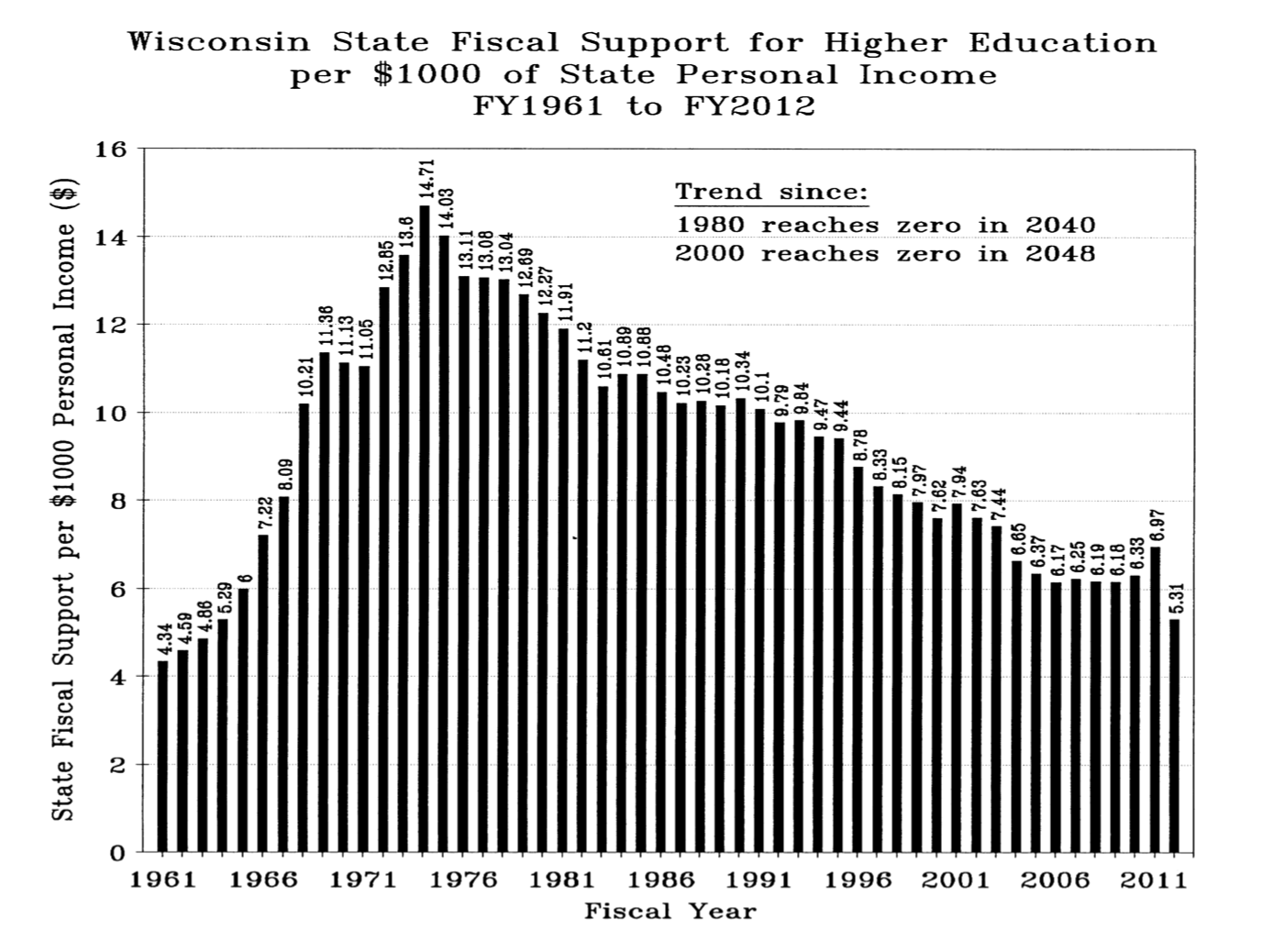
Forty years ago our grandparents elected officials who invested $14 per $1000 of personal income in higher education.  Today, we elect jokers who put in just $5.  What happened?

Figure courtesy of Tom Mortenson, Postsecondary Education Opportunity
Let's admit it: we aren't leaders anymore, we're laggards. Yes, Wisconsin pays taxes, but we throw away far too much of it on other things.  According to Figure 4 in the new report I referenced above, we rank 32nd thanks to the policy choice displayed above-- relative to per capita income, we are outspent by the likes of Mississippi, Alabama, and West Virginia, not to mention our neighbors Illinois, Indiana, Iowa, and Minnesota.

Where is that money going instead? One simple word answers the question: corrections.  To paraphrase Ronald Reagan, we fought a War on Drugs, and drugs won-- but heck, we are still throwing our money at the problem.  Legacy spending, you might call it.   Over the last 10 years, spending on corrections went up 9%, while spending on k12 dropped by 6% and spending on higher education dropped 20%. Right, because clearly the goal of Wisconsin taxpayers is not to help educate our children, but rather to lock 'em up and shut 'em up.

For those who manage to avoid prison and get into college, instead of investing in their future, Wisconsin taxpayers seem to want their families to foot the bill. How's that working for us? Well, enrollment in our public institutions is lagging behind those in other states.  We have experienced far slower growth in fall enrollment as measured over both 5-year and 10-year periods, compared to the national average (see Table 6 here). Perhaps most startling is how little enrollment in our 2-year colleges has changed-- there was practically no change at all in enrollment there over the last 5 years (0.6%) while the national average was 16.7%! Perhaps not coincidentally, during that time, tuition and fees at the 2-years (already higher than the national average 5 years ago) rose by 20%.

I have to admit being persistently perplexed at how other parents throughout Wisconsin can sit idly by while we pour money intended for our kids into pits of despair like the state's correctional facilities.  It is far more cost-effective to educate rather than incarcerate.  It's time to make our policymakers do right by the limited dollars we have. Let's re-instate a real early release plan, and rollback the ridiculous "truth in sentencing" guidelines that lengthened parole time, greatly increasing the likelihood of being returned to prison. As UW-Madison expert Walter Dickey notes, there are numerous hidden costs to incarceration, and as state we simply can't afford to be in the corrections business.   

The best solution is to treat education as the crime-fighting technique it really is.  Providing young people with truly viable opportunities later in life gives them something to really aim for, helping keep them off the streets and on the job.  A recent UW-Madison graduate, economist Ben Cowan, finds that a $1,000 reduction in tuition and fees at two-year colleges is associated with a 26% decline in the number of sexual partners an adolescent has, and a 23% decline in number of days in the past month he used marijuana.  Policies that support affordable higher education may simultaneously support reductions in the costs of incarceration, in a virtuous cycle that is win-win for all.

This is pure common sense and we all know it.  It's simply time we demand that our "leaders" catch up.


Friday, January 20, 2012

Guest Post: UCR Students Promote a Bad Tuition Plan as Police Beat Protesters

The following is a guest post by Bob Samuels, President of the University Council - AFT and a lecturer at UCLA. It is cross-posted from his blog, where you should go to find all of the original hyperlinks. I highly recommend also reading his November entry in the Huffington Post on why public higher education should be free.

The UC Regents meeting had a little of everything this week: UCR students came up with a new way to fund the university, a long list of new salary increases was released, UCSF asked to quit the system, a retired professor was fired, protesters disrupted the meeting, Regents met behind closed doors, and police attacked protesters who were using books as shields.

What does it all mean? Perhaps, it all adds up to the demise of the modern Western social contract. Without being too dramatic, we are seeing an attempt to resist the destruction of the central institutions of modernity: the university, the public commons, and the welfare state. Although it was once taken for granted that everyone should sacrifice for the common public good, this social contract has been broken, and now some are fighting to maintain it, while others are pushing us forward to a more premodern mode of social organization.

A case in point is the UCR “Student Investment Proposal,” which argues that students should pay no tuition while they are in school, but once they graduate, they should pay 5% of their income for 20 years. At first, this appears to be an elegant solution, but it really represents the final privatization of the public university. Instead of relying on state and federal funds and a common tax base, the new system would rely on private citizens to fund their own education through the use of a non-progressive flat tax. Just as UCSF wants to break its ties with the state and the rest of the UC system, this new funding model would allow students to “pay for their own education,” and would get rid of messy things like financial aid and family contributions.

Under this neoliberal payment program, the students working at Starbucks would be paying the same percent of their income to the UC as the students working for hedge funds. Of course, the university would have a strong incentive to only accept wealthy students, since these students have the highest chance of earning a big paycheck in the future. Likewise, there would be no reason to support programs in the humanities and social sciences if the big earners will all go to law school, medical school, and business school. In short, the student proposal is a private solution to a public problem, and yet we are told that the Office of the President will take it seriously.

It is indeed telling that a student group has come up with such a regressive funding model. We can read this as a sign of the way the backlash against the public good has been so successful that even good-intentioned people present anti-social ideas as if they were progressive. While the program does insist that the state should spend 2% of its budget on the UC each year, it does not say how the UC should use this money. Instead, we are told that students will pay for their own education out of their own future earnings. Of course, this model assumes that these students will have a future income in a world where we no longer have any sense of the common good

Saturday, December 3, 2011

Things That Make Me Go Hmm....(Part 2)


Hot off the presses, recent news that has me scratching my head, or otherwise up in arms...

(1) Raising tuition in expensive cities in the midst of an economic crisis. Yep, that's what CUNY thinks is the right thing to do. Hat tip to Tom Hilliard, who pointed me to this incredible inane comment from a CUNY administrator: "What's really driving some of the issues here is the concern about debt and debt upon graduation, and our students as a whole take out little debt, for obvious reasons. The tuition's affordable for those who can pay." Um, yeah.

(2) The White House wades into the quagmire of university admissions, promoting creative thinking on how to achieve diversity. In one sense, just in time, since it sure looks like the Supreme Court is going to end the use of race in admissions by June. On the other hand, I wish the Administration would issue some cautions about how criteria like first-generation status and high school attended are hardly clean proxies for race. Plenty of folks want to do something less controversial, which socioeconomic diversity proxies will accomplish, but they can't and shouldn't pretend the outcomes achieved will be the same.

(3) Jerry Sandusky is innocent? So he says. "I didn't do those things. I'm not the monster I've been made out to be. I didn't engage in sexual activities with those kids." Others told me similar things during a recent trip to Penn State. I don't know, call me naive but I'm inclined to believe the testimony of the 8 or more adults who say they were raped, over the guy who likes to call anal sex "horseplay." I don't care what his "motives" were-- I care what his ACTIONS were. And by the way, does he sound drugged or drunk to anyone else?

Saturday, February 26, 2011

More Flexibility to Raise Tuition?

Central to debates over the New Badger Partnership is the question of whether additional flexibilities that make it possible to raise tuition are desirable.

Evidence can and must be used to make these decisions. A robust, evidence-based debate on our campus is obviously needed but to date has not occurred. Instead, to many of us outside Bascom it seems as though administrators have mostly relied on the input of a few economists and some other folks who work in higher education but are not scholars of higher education. It also seems like seeking advice from those mostly likely to agree with you. (Please--correct me if I'm wrong--very happy to be corrected with evidence on this point.)

It would be wonderful to see a more thorough review of existing evidence and the development of an evaluation plan that will assess positive and negative impacts of any new policy in ways that allow for the identification of policy effects-- not correlations. (Let's be clear: comparing enrollment of Pell recipients before and after the implementation of a policy like the MIU does not count.)

A few years ago I blogged about studies on the effects of tuition and financial aid on individual decision-making. To summarize-- effects of each are relatively small (especially when compared to effects of academic under-preparation, for example) but usually statistically significant. Also, what we call "small" reflects our value judgments, and we must recognize that.

Effects of "sticker shock" are thought to accrue early, such that the "shocked" students end up academically unprepared for college (for example don't even graduate high school) and thus are omitted from the eligible population of students on whom effects of aid and tuition are usually estimated. So hypotheses about sticker shock are very hard to test, partly because a good test requires measuring both the initial "shock" and the resulting behavior many years later (when college enrollment decisions are made).

There are other ways to think about these questions, beyond individual-level analyses. For example, we could contemplate possible effects of tuition hikes and aid increases on overall enrollment (which results from the aggregation of behaviors of many individuals). We could also look at evidence on how common it is for institutions like ours that hike tuition and raise aid to sustain the commitment to that aid over time.

Let's start down that path by examining one study that sheds light on the first of those questions. I will review more such studies in the coming days. My goal is to help facts and figures replace fear as the driving force behind our campus decisions.

*************

In "Rising Tuition and Enrollment in Public Higher Education" Hemelt and Marcotte examine the relationships between tuition and aid on the one hand, and enrollment on the other. Essential to this discussion, for most of their analyses they disaggregate by type of institution, making it possible to isolate effects on universities comparable to UW-Madison.

Using national IPEDS data on public 4-year colleges and universities from 1991 to 2007, the authors find that on average a $100 increase in tuition and fees (in 2006 dollars) would lead to a decline in enrollment of a little more than 0.25 percent. Since we rarely raise tuition by $100, let's instead consider that a $1,000 increase in tuition would result in an enrollment decline of 2.5 percent.

But most relevant to this discussion, these economists find that the tuition elasticity of enrollment is largest at Research I universities-- and they specifically give the example of UW-Madison. According to these scholars, freshmen at universities like Madison's are "much more" affected by tuition increases than students at other kinds of institutions (for example, freshmen at UW-Stout). (The tuition elasticity is -0.24 at Research I's compared to -.107 on average). And, the average amount of aid received has the smallest effects for students at Research I universities, compared to other colleges (.06 on average, compared to .01 at Research 1's).

In plain English, what does this mean? The consequences of raising tuition are greatest for students at places like Madison, and the benefits of increasing aid are smallest.

Why is this? The authors consider the possibility that students at Madison are not weighing the price of Madison relative to the price of Stout or Eau Claire, nor the price of other Big 10 schools writ large, but rather the price of comparably elite Research I institutions. Restricting their analysis to the top 120 public universities in the country, then, they again find that these students are particularly price sensitive, and particularly aid insensitive.

A few words from the authors: "These patterns in price and aid sensitivity are consistent with students opting out of “top 120” schools for competitors as price rises, while finding a way to pay tuition bills at other state schools where students may have fewer options....The evidence...of higher price sensitivity but lower aid sensitivity at “top 120” and Research I institutions raises general questions about enrollment patterns at public four-year colleges and universities, beyond the implications of tuition on enrollment at single institutions. One implication may be a shift of students from higher income families to private institutions or public universities in other states, along with a shift of students from lower income families to less expensive public universities within the state. This would suggest a redistribution of students across public colleges and universities within a state, with those most financially able leaving the system, and others scaling back to enroll at more affordable
institutions. Obviously, student-level data are needed to test this."

Distributional consequences of tuition policies are too rarely considered, and are not addressed in the NBP.

Sure, consequences and benefits should be put into context-- for example considered against the consequences of not raising tuition. But this paper by respected economists clearly indicates that it is not appropriate to assert that increasing financial aid at institutions like UW-Madison will effectively hold students harmless from the negative effects of tuition increases. Enrollment will be affected, and distribution of enrollment across institutions may be particularly affected. Who will measure those effects? And who will care?

Wednesday, October 21, 2009

The Stories We Tell Ourselves

Once upon a time, college students could pay their tuition with a mix of family support, financial aid, and perhaps a little work. Today, family support and aid are woefully inadequate for a broad swath of undergraduates, and full-time work is common.

Is working while in college truly necessary? Are the earnings used for academic expenses related to postsecondary education, or are they frittered away on life's pleasures? Since a handful of studies indicate a negative association between working long hours and rates of degree completion, these questions have taken on broader significance.

Unfortunately, few studies track students' income and expenditures in systematic ways. To better understand spending patterns, and attempt to tease out the reasons for those patterns, one would ideally have longitudinal data collected for a large sample of students, and complemented by in-depth interviews with a sub-sample of students to delve more deeply into the reasons underlying decisions, and validate the measures employed. Now true confession: Together with Doug Harris, I am conducting just such a study right now, the Wisconsin Scholars Longitudinal Study. But that's not why I'm writing this-- we don't yet have data to report on.

But apparently someone else does. A few weeks ago, a news outlet reported the headline "Will Work for Beer," covering the release of a new study from the Bureau of Labor Statistics, published in the Journal of Population Economics. In that study the authors used national cross-sectional data and determined that the earnings students make from work are not enough to replace contributions from their parents, or cover tuition costs. According to the report, "We test several hypotheses regarding the financial motives for and academic effects of college student employment and find empirical support for the hypothesis that a decrease in parental transfers increases the work hours of four-year college students. We also find that an increase in the net price of schooling increases the number of hours worked by both four-year and two-year college students."

Ok. So the decision to work may have something (but not everything) to do with how much support parents provides and how expensive college is. Unsurprising. Not particularly newsworthy.

But the lead author didn't stop there. Instead, she waded into popular stereotypes about college students, telling the reporter that the results mean that the drive to work isn't coming from a need to really make ends meet-- instead, "students...work to have ‘beer money,' money for entertainment, money to pay other expenses, just not their tuition."

Huh?

Her conclusion took a gigantic interpretive leap from her data. Notably, it's not a conclusion found anywhere in the actual research paper. All her evidence suggests is that students' work isn't generating income equivalent to parental contributions or in line with college costs. This could mean many things, including that students have a hard time finding enough work to generate sufficient earnings. Of course it suggests they likely need to find other ways to make ends meet-- including loans. But it says nothing about what they use their work earnings for, how they prioritize expenses, what they go without, etc. With her statement to the press, the author did little more than simply impute meaning to meaningless results.

Why mention "beer money"? It's not uncommon for an academic paper to simply say what it shows-- and conclude that while we need to know more about explanations for patterns in the data, we just don't have the information in the dataset to tell us what we need to know. Why step outside those bounds, and lend fodder to the fire? In what way is this helpful-- to policymakers, to students, or frankly, to anyone?

Working students are often struggling students. There's good qualitative evidence on this, even if the quantitative evidence isn't yet available. Professors dislike them because they tend to fall asleep in class, having been up serving on the graveyard shift instead of studying. Their classmates often don't know them well, since student-employees have little time left for socializing. Their grades are lower than average, their stress levels high, and their chances of degree completion relatively low. So why do we feel the need to minimize their need to work, to mock them for it, to enforce a stereotype that their earnings are spent at bars? It seems nothing less than classist-- in the absence of providing students with sufficient financial supports to make working during college truly optional, we try and make ourselves feel better by telling stories that students work not out of true financial need, but rather a desire to imbibe.

Maybe that helps some fraction of folks sleep at night, but I seriously doubt it's grounded in any kind of truth.
Posting Lama ►
 

Followers

Alexa

Copyright 2013 Education for Everyone: tuition Template by CB Blogger Template. Powered by Blogger