Wednesday, April 3, 2013

Those Selfish PhD Candidates

One of the most stunning moments in the recent Ed Talks Wisconsin came towards the end of a Friday night discussion about MOOCs. The room was heavily populated with graduate students, many of whom were asking about the implications of these online courses for their employment prospects.  With the decoupling of teaching from their future responsibilities, many were (rightly) worried about how they'd be trained, funded, and what they'd do post degree.

As one student put it,"What's the incentive for the next generation of scholars to pursue a PhD?"
 
In response to that question, the Chancellor of the UW Colleges, Ray Cross, responded this way:
"Is your goal to get a PhD, or is your goal to change education?"

Many in the room looked up, confused about whether he was serious.

Well, an email that just arrived from UW-Madison suggests he was.  The newsletter it included contained the following key blurb:

"New program trains students to create online courses.  With the advent of online courses and degrees, a new program will teach students how to provide online course support. Student Online Course Support (SOCS) will help students find campus tech-related jobs, expose them to new career paths, and save the University funds by hiring student support. Tell your students about this opportunity."

Got that? It's full-speed ahead in support of the Flex Degree and the MOOCs here at Madison; above I linked to the course description that explicitly references these programs. Want a campus job? Get on board. And be sure, of course, to save the university money!

Will this next become a mandated part of our graduate training? Or will we no longer need those folks, as our younger Badger are trained and ready to serve?


ps. The video of Cross starts around the 1:32 minute mark.

Advice for Chancellor Blank from a UW Employee

This afternoon I received the following email from a UW employee who, unlike myself, does not enjoy tenure and thus prefers to convey this advice to the incoming chancellor anonymously.  I recognize and sympathize with that concern, and thus am simply reprinting it here in full.  I believe this advice, coming from someone with plenty of experience at the institution, is worth full consideration. If you have your own words of advice to share, please send them along!


Dear Dr. Goldrick-Rab –

If Dr. Blank is willing to listen to you, and I hope she does, one thing you might want to suggest is that she does not start calling herself “Becky” but instead be referred to as Rebecca when she wants to go “casual.”

David Ward was never been referred to by anyone as “Dave,” and if John Wiley had a nickname or pet name as a child, he certainly did not use that on his official correspondence or when he was quoted in the press.   This is, after all, the University of Wisconsin-Madison.   Excellence in teaching and research is how we convince people to give us their money or send us their children to educate. 

Trying to be cute or folksy is not what the alumni, citizens, or corporate  and foundation donors are looking for.  Two of my children were enrolled at UW-Madison when “Biddy” was the Chancellor, and neither one of them understood where the widely reported “love” that all the students at Wisconsin supposedly had for Biddy came from.

Thank you.

Sunday, March 31, 2013

Net Price Confusion

Today's NY Times notes the importance of considering the net price families pay for college, not the sticker price, using an example from Wisconsin. Specifically, in a column by David Leonhardt, Professor Sarah Turner presents data from the College Navigator tool (which in turn draws on the 2009-2010 IPEDS information) to show that "at the less-selective campuses in the University of Wisconsin system, for example, the average net annual cost for a year of tuition, room, board and fees in 2010-11 was almost $10,000 for families making less than $30,000, Ms. Turner said. At the flagship campus in Madison, by contrast, the equivalent net cost was $6,000."

While I'm certainly friendly to Turner's primary point-- that because of institutional financial aid attending the state's flagship may be effectively less expensive for needy students than attending another public university-- the recitation of this figure gave me cause for concern.

First, as I pointed out here, $6,000 remains a darn lot of money for families making less than $30,000.  We need to stop and realize that paying (or borrowing) at least 20% (and probably more) of your income for college is beyond the realm of possibility for most low-income families.

But secondly, and more importantly this particular conclusion is outdated.  Look at UW-Madison's website for its net price calculator for 2013-2014.  There, a Wisconsin resident family with an expected family contribution of $0 (incomes usually well below $30,000) is said to face a net price of $13,635.   That's way up from 2010-2011.   So, either these numbers reflect enormous increases in net price over time at Madison, or something else is off.  Using those current numbers, the comparison for  UW-Oshkosh is a net price of $10,101 for a Wisconsin resident with an $EFC of $0 and at UW-Platteville it is $8,593.

Despite claims at our rapid tuition increases were being offset by financial aid holding the poorest students "harmless" things have rapidly changed at UW-Madison. We went from offering one of the lowest net prices for poor students in the state to being among the least affordable for those same people. This seems to be because the cost of attendance at Madison jumped from $21,617 in 2010-2011 to $24,404 in 2013-2014, increases were not nearly so substantial at the other System schools, and aid did not increase at the same rate.

Punchline: despite what the New York Times and federal data indicate, today it is not cheaper for a low-income student to attend UW-Madison compared to another in-state university. It once was, but things have changed for the worse.   The payback at Madison may be greater, but let's not pretend that simply "knowing the net price" makes this decision simple or easy.


Book Review: Hope Against Hope by Sarah Carr

A couple of months ago, I tweeted an inquiry to find out who was doing thoughtful, critical research on the transformations in education taking place in New Orleans.  After reading Naomi Klein's Shock Doctrine and getting a better picture of the grander aims some people have for New Orleans as a "great experiment," I wanted to gain insights into the lived experiences of parents and children going through it.

As usual, Twitter was incredibly helpful: multiple sources directed me to the work of Adrienne Dixson and Sarah Carr.  After reading some of their work, I immediately invited them to participate in Ed Talks Wisconsin, and the Educational Policy Studies conference that followed it.

I then began carving out time each evening to work my way through Sarah's new book Hope Against Hope: Three Schools, One City, and the Struggle to Educate America's Children.  After two nights, I found myself genuinely looking forward to reading more, rushing through my evening activities to get back to the book. This is a rare experience for me; I found Carr's writing at least as engrossing as Rebecca Skloot's and Jason DeParle's, and think that's high praise.

There are many distinctive features of Hope Against Hope and some of them are clearly attributable to Carr's experiences as a Spencer Foundation-supported fellow and part of the Hechinger Institute collective. Her writing on school choice is well-informed by academic research on all sides and she clearly sampled her cases of schools, teachers, and families to provide substantial opportunity for both proponents and opponents of school choice--and those caught in the middle--to share their stories.  Carr is also comfortable with conflict and tension; the arc of her narratives lead us to no easy conclusions and much uncertainty about placing any normative judgements on what's "right" or "wrong" about school choice.

That attribute proved most helpful to me.  After reading the book and listening to Carr speak about it on a panel moderated by Gloria Ladson-Billings, and having a rich discussion with my colleague Michael Fultz, I found myself rethinking the way in which Progressives, myself included, talk about the choices made by African-Americans in contexts like New Orleans. In a nutshell, until reading Carr, my arguments gave Black families very little agency and White public school proponents too little responsibility.  Essentially, knowing the ways in which market-based regimes were capitalizing on the inequities in the public school system to promote alternative, distinctly non-public, non-democratic solutions, solutions that I strongly suspect will worsen the conditions of Black schooling over time, I wanted everyone to flat out reject them.  Engaging in school choice was tantamount to endorsing the work of the neoliberal project, and thus should be avoided.

What the book makes clear is that this is a bit much to expect, and is even inappropriate because it manages to romanticize a public school system that is undeserving of such treatment. While I reject the idea that the public schools are "broken" or "failing" I also reject the idea that they are achieving their mission at this point, especially for marginalized families and students.  I've come to think that it's not only idealistic and naive but also arrogant for me, a wealthy, well-educated White woman, to demand that anyone persist in that system while we work to improve it.  We can wish they would, we can beg and plead, we can explain the long-term consequences of moving outside it in the near term, but we denigrate the decisions of Black and Latino families to seek school choice right now at our peril.  Not only will we perpetuate the worst parts of the public system, but we will lose valuable allies and voters.

Hope Against Hope helped me understand the depth of the rut in which we're stuck.  The school choice options provided by schools like KIPP are clearly stratified, intended for some peoples' children and not others.  It seems highly unlikely that the leaders of KIPP schools will send their own kids to them.  That's not to put down the hard work of the KIPP teachers-- boy are they impressive, and how angry was I to read about how exploited and overworked they are!  Why are we burning out these people, instead of building their capacity for long-term good.  But no matter how good they are, the way they run schools, teaching conformity and obedience, will never be the way that middle and upper-class children are schooled. It's thus no more equitable an option than our current system, and with its undemocratic managerial practices, ultimately a worse one.

On the other hand, the public schools, while full of amazing hard-working teachers and staff who give their everything to kids, are hard-pressed to bring their best practices to scale.  Carr's portrait of a public school principal is heart-breaking.  The only way in which she fails is in her efforts to garner more financial support. That's obviously not a personal failure but one facilitated by the Progressives, who haven't engaged in systematic developments of strategy and narratives in any way akin to what the Right has achieved. As Mike Apple reminds us, we simply must begin doing this. It's already practically too late.

In her writing, Carr strikes me as incredibly balanced. I honestly wasn't sure where she stood politically on school choice until I heard her speak at Madison.  There, she made some beautiful statements about the grey spaces in the debate that will stay with me for a long time. Corporations are occupying spaces meant for teachers and parents in education conversations, but teachers and parents must not only join but find clear things to demand.  She noted that the narrative of "ceaseless unending change" is allowing charter schools to try whatever they see fit with Black children.  Where is "change" in the public school narrative?

These are important questions, and I urge you to pick up this book and engage.  You can also check out Carr with Barbara Miner and Gloria Ladson-Billings in Ed Talks here:


Wednesday, March 27, 2013

How Sticker Shock Happens

A colleague who is skeptical of my argument that students and families are susceptible to sticker shock, and that this particularly affects the choices of those without financial strength, raising a good question: If these students and families don't know about financial aid (or changes in financial aid), why would they know about institutional sticker price (or changes in institutional stick price)?

The answer appeared during a trip I took on the New York City subway today. Look at this ad and you tell me-- isn't the message quite clear?  If this is the number you see as you stare at subways ads for an hour commute to work, don't you think it will sink in?  With so many ads all the time telling the buyer "Trust us, big discount! Just file papers!" why would anyone believe another one, let alone one that comes with a long complex set of forms.


It's a mistake to focus merely on the question of whether a net price intervention can move the dial a bit, helping some students overcome sticker shock. That's just a tiny chip at the iceberg. Instead, consider the massive iceberg we're created, allowing sticker prize to escalate, and begin to melt it.

Friday, March 22, 2013

Cautions for Chancellor Blank

It seems UW-Madison's system of shared governance may be a new act for Chancellor Rebecca Blank to learn.  An interview conducted with journalists today shows her on the record weighing in on both tuition strategies and the composition of the student body.

A word to the wise:  This year the University Committee charged two committees to work on these exact issues.  The tuition committee has been meeting and working hard all year long -- hiking out-of-state tuition and differentiating tuition further by school or college are strategies that come with significant potential consequences.  Reciprocity with Minnesota is costing the university a great deal of money and ending it should not be dismissed out of hand.  Regardless, these are not choices made simply by the chancellor, but by the shared governance system.  In addition, the Committee on Undergraduate Recruitment, Admissions, and Financial Aid was tasked with developing a profile of the ideal freshman class and working on ways to achieve it.  Chancellor Blank does not decide where students "should" come from-- we all do.

Hopefully these are just initial missteps on her part. Hopefully the next time she is asked about these things, she'll inform reporters that it's impossible at this stage to say what will come next, since she hasn't spent time on campus in decades.  And hopefully she will schedule a "telebriefing" with shared governance groups soon, seeing as how the one with reporters is now over.

Tuesday, March 19, 2013

What Have We Done to the Talented Poor?

Sunday's New York Times carried a front page story on a crisis in American higher education. I think that's excellent, and I'm thrilled for Caroline Hoxby and Chris Avery, whose research is featured. These economists managed to draw national attention to a major problem-- despite decades of public and private investment, barely 1 in 10 children from low-income families earns a bachelor's degree. And this isn't because they aren't smart, or aren't taking college admissions exams-- plenty of them taking many of the right steps towards college.  But they are not ending up there.

Hoxby and Avery begin to help us understand why by evaluating the merits of several urban legends, two of which are repeated by seemingly every elite college admissions officer in the country:

(1) "We don't have more Pell recipients on campus because there are simply too few students from low-income families academically qualified to get in here."  In other words, bright poor kids just don't exist in large numbers.

(2) "We don't have more Pell recipients on campus because every qualified student from a low-income family is already taken by another great college." This is just a twist on the first claim.

As I've long suspected, and have argued at my own institution for many years, the data prove both of these statements wrong.  First, there are plenty of very bright students from low-income families graduating from high school.  In fact, very high-achieving, high-income students only outnumber high-achieving, low-income students by 2.5:1.  According to the authors, "there are at least 25,000 and probably something like 35,000 low-income high achievers in the U.S."  Second, many of these amazing students aren't attending any great college. In fact, they aren't even applying.

So there's the main punchline of their new paper: high-ability low-income students do exist, and they aren't in college because they haven't applied.

Moving on from there, Hoxby and Avery stroll onto shakier ground.  The title of the New York Times article  their hypothesis about why these students aren't applying to top colleges:  "Better Colleges Failing to Lure Talented Poor."   The authors  suggest that problem resides with admissions officers who aren't using appropriate methods to recruit these students.  They go through many analyses to show why this is likely a problem, and their arguments are compelling.  Every enrollment manager needs to consider them.

But this is hardly a full accounting of every possible explanation.  I'd like to offer this headline instead: "Better Colleges Charge a Lot of Money and Scare Off the Talented Poor."

Everyone knows that a top college comes with a high sticker price.  Hoxby and Avery dismiss this by noting that the net price is often lower at top colleges because they also provide more financial aid.  But assuming that net price matters more than sticker price is a major assumption; it is guided by economic theory but rarely ever tested.  My own work suggests that one reason it may not bear out in practice is that responding to sticker price, rather than net price, is not merely a reflection of information asymmetries (e.g. lower-income families are less likely to know about the availability of financial aid), but also a reflection of differences in the extent to which families trust the major social institutions to actually help them.

Hoxby and Avery do not acknowledge this.  They frame the decision not to attend a top college as  irrational, writing that "added to the puzzle is the fact that very selective institutions not only offer students much richer instructional, extracurricular, and other resources, they also offer high-achieving, low-income students so much financial aid that the students would often pay less to attend a selective institution than the far less selective or nonselective post-secondary institutions that most of them do attend....[the students'] choices are odd because although the private match colleges might offer fewer scholarships that are explicitly merit-based, they offer much more generous need-based aid so that the student would pay less to attend and would enjoy substantially more resources. Furthermore, it is almost never sensible for a low-income student to apply to a single private, selective college: he may be able to use competing aid offers to improve the aid package he gets from his most preferred college."  Clearly, if only students from low-income families used the net price calculator, they'd opt to apply-- right?  How do we know this?

Hoxby and Avery also dismiss the idea that sticker shock explains the lack of low-income students at expensive colleges because they observe few income differences in the behaviors of college applicants.  As in other studies, among students who apply to college, low and high income students behave similarly.

So what? This simply means that the effects of sticker shock may affect the application decision but not the enrollment decision, and this makes utter sense.  Trust in schools plays a major role in families' educational decisions.  The fact that over the last 30 years the sticker price at most top colleges and universities has skyrocketed, rising more rapidly than inflation, and making headlines, leaves little reason for people with little financial strength to trust in them.  Moreover, those sticker prices rise even after their kids enroll, their financial aid packages change from year to year, the FAFSA must be refiled again and again, and grants are often replaced with loans once a school has lured the student in the door.  Why would anyone trust these places?  Why would smart students who've watched their families suffer in an exceedingly wealthy society like this one trust the system to give them the money required to make attendance at an elite college possible?  Especially when they won't be "shown the money" until after they have applied, been accepted, and are on the brink of enrollment?  Furthermore, we have the gall to expect them not only to trust these schools but to believe that it's possible to negotiate with them?  The act of applying is an act of trust and faith in what's widely understood to be a highly rigged system, so looking at the behaviors of applicants post-application makes little sense.

The Hoxby and Avery view of the world is pervasive among researchers, and leads many economists to suggest that raising tuition is no big deal if you can simply "hold students harmless" with financial aid. We suffered through a regime of that leadership here at UW-Madison several years ago, and while many departments are enjoying the extra revenue from the tuition, the representation of first generation students on campus is falling.  None of our institutional reports examines the impacts of our tuition hikes on applicant behavior.  By solely comparing our figures to college applicants, or worse yet enrolled students, you can convince yourself that tuition hikes do no harm. But when you see such clear evidence that talented poor students stay out of the applicant pool, you really have to wonder.  Do they simply not know that your college exists, or how to apply?  Or might they actually believe that they cannot afford it?

They aren't wrong to feel this way. Let's take the case of UW-Madison, where most professors and students on campus suggest that our price is still affordable because we distribute financial aid.  Consider the net price of college attendance, taking the sticker price and subtracting all grant aid. (My team's research in Wisconsin reveals that students do not think of loans as financial aid, do not feel they are 'help' and endure quite a bit of stress from them.):

My graduate student Robert Kelchen produced these figures for the 3,487 first-time, full-time, degree-seeking freshmen who are in-state students. The first thing to note that we can only calculate net price  for the 1,983 students receiving Title IV aid. This means that just under half of all in-state Madison freshmen do not file the FAFSA.  Is that because they aren't qualified for aid, or because they do not know they can or should? Second, look at the net price faced by students according to their family income:

$0-$30k:          $6,363 (n=212)
$30L-$48k:    $10,098 (n=232)
$48K-$75k:    $15,286 (n=406)
$75-$110k:     $19,482 (n=542)
$110+k:          $20,442 (n=591)


Ok, so now you look at these numbers and think, hmm. Is $6,363 a good deal for a year of college?
Well, let's consider that relative to their family income. Here is the cost burden relative to the midpoint income in each bracket:

0-30k:  42%
30-48k: 26%
48-75k: 25%
75-110k: 21%
110+k: 18% or less


There you have it.  At UW-Madison we expect the poorest families to contribute far more of their family income to attend college than we expect from the richest families.  Yes, the poorest folks get more aid, but it's far from proportional to their need.  Why would we expect them to buy into such a system?

Researchers, and especially economists, need to get out in the world and talk to real families and students who do not enjoy the benefits of tenure and stable incomes. Only 16% of parents nationwide will ignore the cost of tuition when helping their kids choose a college, according to a new survey, and I'm betting this is even less common among poorer families. The survey also shows that one in five parents refuses to take on any debt for their kids to go to college, and among families earning less than $3,000 a month, 25% aren't sure if they'd take on any debt, and only 28% are willing to borrow $20,000 or more. Barely one in five of these poor families think it's reasonable for their child to accumulate even $20,000 in debt over four years.

Yes, there is a fair bit of financial aid out there, but it increasingly comes in the form of loans or scholarships with strings attached which can be easily lost, creating financial instability.   An alternative interpretation of Avery and Hoxby's results is that rather than taking a chance on expensive institutions they can't trust, many high ability low-income students are revealing a preference for lower-priced institutions.  They might occasionally apply to one pricey dream school, but it's more likely reflecting a quick momentary aspiration, rather than an actual plan.   They live in the 21st century where affordability is an indicator of quality, not the 1980s where the pricier the college or restaurant, the better it must be.  They know they are living proof that the nation isn't a meritocracy; they see their families work hard every day and get nowhere.  Ignoring their savvy and discounting it as irrational, providing them with net price calculators rather than investing in high-quality free public options-- well, it's actually sort of insulting.  It's time to consider the possibility that getting smart striving young people in search of upward mobility to apply to and attend good colleges will require transforming our system to focus public investments on ensuring real access and opportunity for all Americans, rather than subsidizing the choices of the middle class.  The current system of voucher-provided financial aid is now decades old and according to this study, it may be failing. It's time to consider a restart.


Note: I thank Zakiya Smith for a helpful clarifying Twitter conversation that led to some revision.

Postscript.  As it turns out, Hoxby and Sarah Turner have been conducting a very important randomized trial on the effectiveness of several intervention strategies aimed at helping more talented poor students enroll in college, and I've finally gotten a look at the forthcoming results.  They show that a combination of better information about college graduation rates, information on the net price of various colleges, and fee waivers for applications is effective at boosting application and enrollment rates of the talented poor substantially. Moreover, their strategy is cheap!  This is wonderful news. But what does it tell us about the importance of sticker shock-- the topic of this blog? Unfortunately, not much.  In this case, the intervention most clearly aimed at addressing sticker shock is a net price calculator.  That sort of intervention assumes that the "problem" of sticker shock is mainly informational.  As I said above, I think that the issue of sticker shock involves more than information, it also involves trust.   Being told that a college is likely to give you aid is not the same thing as getting the aid.  In their trial, the authors find that the impacts of the net price calculator are significant but not as important as the other interventions.  Again, it would be wrong to interpret this to mean that sticker shock is unimportant, since this is not a test of sticker shock.  It is a test of a net price calculator.  In contrast, the fee waiver information they provide is real money, on the table, with a high probability of receipt. They find that this has larger effects than the net price calculator, and I think that supports the idea that a real concern about money actually being available is inhibiting the actions of these talented poor students.  For sure, it's not the only factor affecting their behavior, but it's worth attending to since even with this entire package of Hoxby/Turner interventions, a substantial fraction of the income gap in college behaviors remains among talented students.  Moreover, a large income gap persists among less-talented, but nonetheless very important, students who aim to attend and graduate from college.

Postscript 2. The numbers I quoted above are clearly out of data based on UW-Madison's website. The situation seems to have worsened.


On Process

Paul Fanlund's column today on the process through which Rebecca Blank was selected as chancellor raises some very important questions.  These strike me as the sorts of questions that one should ask regardless of whether or not they agree with the choice of Blank.  After all, these process issues go to the heart of how we select a chancellor at a shared governance institution.

1. How are we to know whom the campus "unanimously" supports?

The current practice is that the process of official input from shared governance bodies ends when the search and screen committee names its four finalists.

When that committee meets with the Regents special committee, it is to provide input on what people on campus said about all of the candidates.  At no point in the Blank search did the search and screen committee have the opportunity to tell the Regent committee whom the campus "unanimously" chose. Moreover, the search and screen committee did not have a clear selection of a candidate-- there was widespread disagreement.

This should be changed to allow the shared governance search and screen the chance to officially vote on a candidate after campus visits, just as they do when hiring a faculty member.  At the very least, that official vote could be conveyed to the Regents.

2. Why is the campus asked to write in with their comments about candidates if there is no official process through which that information is compiled and shared?

Comments were received through 5 pm Thursday evening. The shared governance committee met with the Regents Friday morning, and the decision was made that same day.  What was done with all of those submitted emails in the meantime? Were they counted?  Did they reflect "unanimous" support from campus groups?

This has the potential to greatly reduce campus involvement in the process.  There should be a transparent process through which feedback is collected and the information systematically made available to decision-makers well before the decision is made.

3. Which campus groups are prioritized in the selection of a chancellor?

Fanlund's article says that Blank was unanimously supported "by the various campus constituencies that include campus deans, the University Committee, which is the executive committee of the Faculty Senate, as well as affiliated entities such as the Wisconsin Alumni Research Foundation (WARF) and the Wisconsin Alumni Association."

What about the Associated Students of Madison?  Academic Staff? These are two of the three shared governance bodies and yet are not mentioned, while WARF and WAA, not part of shared governance, are.  Who are Fanlund's "not for attribution sources" and what does this set of priorities reflect?

The shared governance bodies should have clear priority in this effort.

4.  Is it appropriate for the shared governance Search and Screen Committee to be forbidden by the search firm from exploring the candidate's background (aka conducting "due diligence") other than through their written materials?  Why does that committee's last vote come without full information?

Again, this is a recipe for disaster. It should not be allowed in future searches. Frankly, the search firm should not be allowed to do anything more than recruit candidates.  Members should not attend interviews or create rules for a shared governance committee.

Finally, as someone who appreciates empirical evidence, I have just two last remarks.  I am struck by the fact that Fanlund opens his article by noting that Blank met with the Regents "without seeming to survey eyes around the room to gauge what interviewers wanted to hear" and finished 20 minutes early, and yet was judged to be an "effective listener.""Her ability to communicate" was judged of key importance.  How is this possible?  Not only do these observations stand at odds with the characteristics of good listeners, but many people, including Professor Chad Goldberg, student committees, and I all observed a pattern of not listening and not answering questions in a straightforward manner.  Since we all entered the process very excited to have a liberal social scientist become chancellor, it seems unlikely that we ignored strong communication skills. How can we make sense of this?

In a similar vein, what information did the Regents use to conclude that Blank was comfortable with shared governance?  The only available statements from shared governance members indicate significant concerns with her interactions with those members.  What assessment protocol did they use to determine this was incorrect?

Given that, as Fanlund notes, "there seemed to be much focus during this process on not repeating what was now regarded as a mistake in having hired Martin in 2008" and given that the known mistake was in the Regents' selection of Biddy Martin over Rebecca Blank (the campus pick)-- and that fast forward several years it seems we may be here yet again, with Rebecca Blank chosen over Michael Schill (whom I'm told by my 'sources' was the pick of many, many people on the search & screen, and the students), well...this is all quite odd.  What's also amazing is the amount of attention the media has devoted to covering the outcome of the search, rather than doing the kind of investigative reporting needed to ensure that major social institutions are accountable and responsive to their publics.  I imagine that when you know no one will ask questions, it's awfully easy to act as if you'll never have to provide answers.


UFAS Reaction to Appointment of Rebecca Blank as Chancellor


This post is by Chad Goldberg, Professor of Sociology at UW-Madison and Vice President of United Faculty and Staff, the campus unit of the American Federation of Teachers. As a card-carrying member, I am proud to provide this outlet to Chad to share his thoughts.

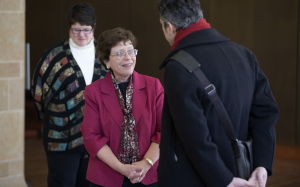
Chad and Rebecca meet, 2013


Monday, March 18, 2013

Welcome, Chancellor Rebecca Blank


This blog is called the Education Optimists and so it's with great hope and the strong desire to be pleasantly surprised that I am responding to the announcement that Dr. Rebecca Blank is the next chancellor of UW-Madison.

First, the good news.  With Blank at the helm, we can expect that the thoughtful scholars of the Institute for Research on Poverty and the La Follette School of Public Affairs will play an important role in the direction of our institution in coming years.  I suspect policy formation on affordability and tuition will be guided by Bob Haveman, Chris Taber, and Karl Scholz, efforts on diversity and access will be led by Bobbi Wolfe, and our interactions with social policies throughout the state will be shaped by Tim Smeeding. These labor economists are experts in their field, and will undoubtedly constitute a vocal cabinet for Blank.  

Second, the Social Sciences will flourish under Blank's direction. As a sociologist, that's nice to know.

Third, I expect Blank will surprise me by being an entirely different leader than Biddy Martin, stunning us all with her commitments to widening access to UW-Madison and keeping it affordable.  Her expertise is in poverty studies, and so I hope that under her policies, we will see far more students from low-income Wisconsin families take their places in our classrooms.   Twenty percent or more of our student body should receive Pell Grants, and the percent of students from first generation families must begin to rise.  If she can accomplish this, I will loudly applaud.

So- I'm pleased as punch to be putting the word Chancellor next to Rebecca Blank's name, especially given that the apparent alternative was Kim Wilcox.  I suspect Blank was the campus "pick," if that matters.  As for me, I hope that some day I will get to work with Michael Schill-- and at minimum I won't soon forget how sincerely he tried to serve Wisconsin by taking the helm. In the meantime, I'm looking forward to my coming sabbatical and the next many years freed from campus service;  with so many existing campus friends and experts in the relevant areas, Dr. Blank is well-equipped to decide how to achieve her goals. Godspeed, and On Wisconsin!


◄ Posting Baru Posting Lama ►
 

Followers

Alexa

Copyright 2013 Education for Everyone Template by CB Blogger Template. Powered by Blogger